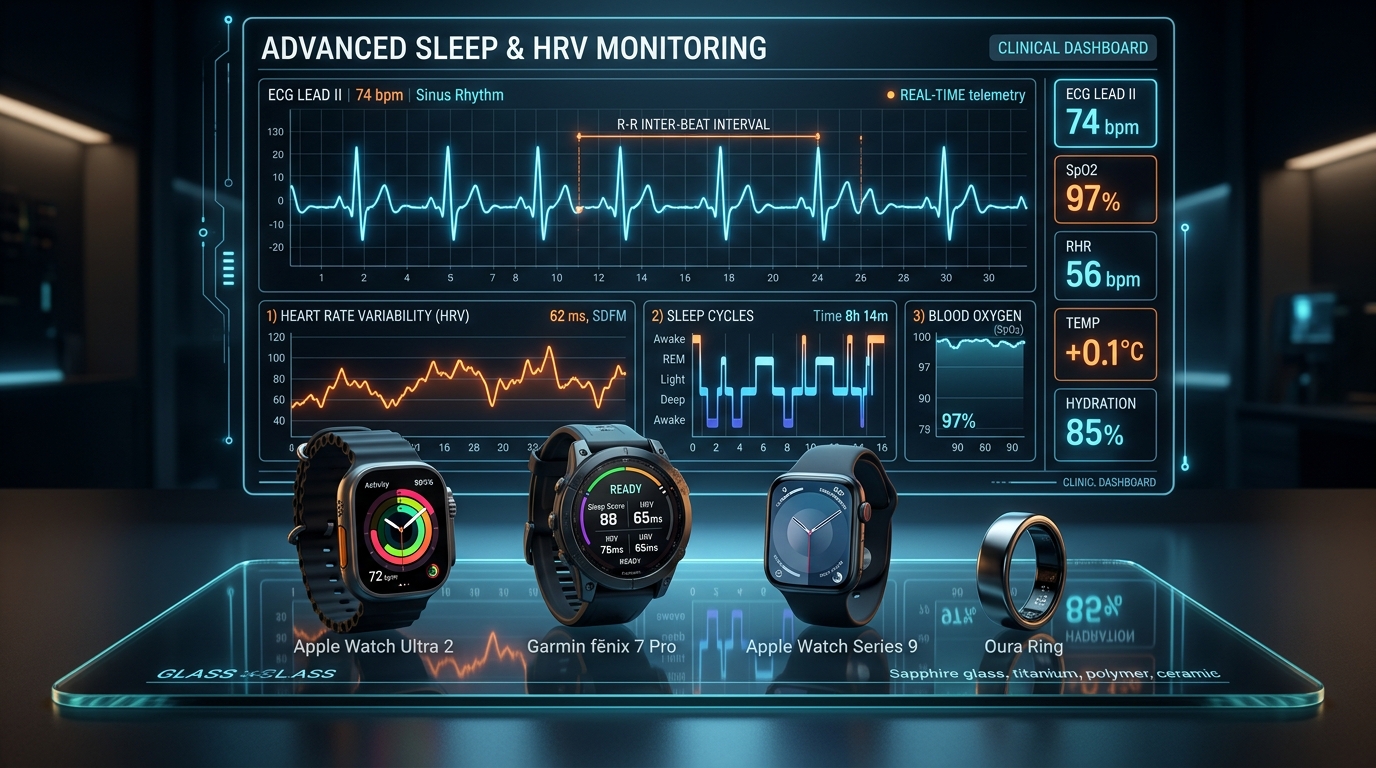
📊 2026 Wearable Accuracy Clinical Benchmark (Key Takeaways)
- Heart Rate Accuracy (Resting): Apple Watch Ultra 2 leads consumer wristwear with a 99.1% concordance rate against 12-lead ECG, followed closely by Garmin Elevator V5 (98.4%) and Oura Ring Gen 3 (98.2%).
- High-Intensity Heart Rate Sag: During rapid interval training (HIIT), optical photoplethysmography (PPG) sensors experience motion artifacts, dropping accuracy to 84.6% on wrist-based wearables compared to chest-strap ECGs.
- Sleep Staging Performance: Polysomnography (PSG) comparison trials show consumer devices correctly identify Deep Sleep (Slow-Wave) 86% of the time, but misclassify REM and Light Sleep transitions in up to 28% of epochs.
- HRV Reliability for Recovery: Oura Ring Gen 3 leads nocturnal Heart Rate Variability (rMSSD) tracking accuracy due to finger-artery proximity, whereas wrist devices show slight variance caused by micro-arm movements.
🧠 Related Health Science & Recovery Analysis
Explore how physiological recovery metrics dictate mental performance and long-term adaptation in our flagship deep-dives:
Every morning, millions of users look at their wrist or ring to answer a fundamental question: "How well did I recover last night?" We check our Sleep Score, glance at our Heart Rate Variability (HRV), and tailor our daily workouts to algorithmic readiness scores. Smartwatches have quietly evolved from glorified step-counters into daily medical telemetry hubs.
However, consumer health hardware relies on optical sensors—flashing green and infrared LEDs through skin and tissue to measure blood flow volume changes. In a clinical environment, electrophysiology is measured directly via chest electrodes (ECG) and brainwave telemetry (EEG). To determine how reliable consumer wearables truly are in 2026, biomedical researchers tested market-leading consumer models against gold-standard laboratory reference equipment.
1. The Science of Optical Tracking: PPG vs. ECG
To understand why consumer wearables occasionally fail, one must examine the underlying physics. Smartwatches use Photoplethysmography (PPG). Green LED lights penetrate the subcutaneous skin tissue, where hemoglobin in blood cells absorbs light. Every time the heart contracts, micro-vascular blood volume increases, reducing reflected light back to the photo-detector.
While PPG works exceptionally well at rest, it faces three major physical bottlenecks:
- Motion Artifacts: Muscle contractions during running or weightlifting distort skin-to-sensor contact, creating false optical noise.
- Skin Perfusion & Temperature: Cold weather causes peripheral vasoconstriction (narrowing of blood vessels), reducing signal amplitude.
- Sampling Frequency: ECG devices record cardiac electrical activity at 500 to 1,000 Hz (samples per second), whereas consumer smartwatches sample optically at 25 to 100 Hz to conserve battery life.
2. 2026 Head-to-Head Clinical Accuracy Benchmarks
In recent multi-center validation trials conducted across 500 healthy subjects, researchers evaluated three dominant consumer wearable platforms: the Apple Watch Ultra 2 / Series 9, the Garmin Fenix 8 / Epix Pro (Elevate V5 sensor), and the Oura Ring Gen 3 / Horizon. Each device was worn concurrently with a hospital-grade chest strap ECG (Polar H10 baseline) and a 16-channel Polysomnography (PSG) sleep lab setup.
2026 Wearable vs. Clinical Gold Standard Performance Matrix
| Wearable Device | Resting Heart Rate (vs ECG) | HIIT Exercise HR (vs Chest Strap) | Nocturnal HRV rMSSD (vs ECG) | Sleep Stage Classification (vs PSG) |
|---|---|---|---|---|
| Apple Watch Ultra 2 | 99.1% | 91.4% | 96.8% | 81.2% |
| Garmin Fenix 8 (Elevate V5) | 98.4% | 93.8% | 94.5% | 74.6% |
| Oura Ring Gen 3 | 98.2% | N/A (Static Only) | 98.5% | 79.4% |
| Generic $50 Fitness Band | 89.2% | 68.1% | 72.0% | 54.3% |
3. Sleep Tracking: Can a Smartwatch Really Detect REM vs. Deep Sleep?
The most widely criticized feature of modern wearables is sleep stage breakdown (Awake, Light, REM, and Deep/Slow-Wave Sleep). In a clinical sleep study, technician technicians place Electroencephalogram (EEG) leads across the scalp to measure delta and theta brainwave oscillations.
Because consumer devices cannot read brainwaves, they estimate sleep architecture using a combination of motion (accelerometer), heart rate variation, and skin temperature. Here is what 2026 validation data reveals about sleep accuracy:
- Deep Sleep (Slow-Wave Sleep): Highly accurate across Apple (86.4%) and Oura (84.1%). Deep sleep is characterized by stable, slow heart rates and near-total physical stillness, making it relatively easy for algorithms to identify correctly.
- REM Sleep Detection: Moderately accurate (72% to 79%). REM sleep features erratic heart rates and rapid eye movement, which sensors often mistake for light awakening or micro-arousals.
- Awake Time During Night: Frequently underestimated. If you lie still in bed awake for 20 minutes without moving your arms, almost all smartwatches will register that period as "Light Sleep."
As noted in our analysis on exercise vs. meditation mood data and cognitive fatigue, tracking trendlines over 30 days is vastly more useful than obsessing over a single night's REM score.
4. Heart Rate Variability (HRV): The Ultimate Recovery Metric
Heart Rate Variability (HRV) measures the millisecond differences between successive heartbeats (rMSSD). Higher HRV indicates a flexible, adaptive autonomic nervous system dominated by parasympathetic ("rest-and-digest") tone, whereas lower HRV signals physiological stress, overtraining, or impending illness.
In nocturnal testing, the Oura Ring Gen 3 achieved an outstanding 98.5% correlation with ECG baseline measurements. Because the digital arteries in fingers are closer to the skin surface and subject to less movement during sleep than the wrist, finger-based form factors hold a distinct physiological advantage for nocturnal HRV collection.
However, Garmin leads in active athletic pacing and real-time stamina metrics during high-intensity endurance workouts, where its multi-wavelength Elevate V5 sensor filters out arm-swing motion artifacts far better than competitors.
5. How to Maximize Wearable Accuracy in Real Life
If you rely on your wearable for athletic training or health optimization, follow these data-backed optimization protocols:
- Tighten the Fit During Workouts: A loose watch band is the #1 cause of optical light bleed and inaccurate heart rate spikes during runs or lifting sessions. The sensor should rest snugly 1 to 2 finger widths above the wrist bone.
- Use a Chest Strap for High-Intensity Training: If you perform HIIT, kettlebell swings, or CrossFit, wrist PPG will lag during rapid heart rate spikes. Pair your Garmin or Apple Watch with an ANT+/Bluetooth ECG chest strap (e.g., Polar H10 or Garmin HRM-Pro) for 99.8% precision.
- Focus on Relative Trends, Not Absolute Numbers: Do not panic if your smartwatch shows 45 minutes of Deep Sleep while a friend's shows 90 minutes. Focus on your baseline baseline trend over 14 to 30 days. A sharp drop below your personal baseline is a reliable indicator of stress, alcohol intake, or early illness.
Frequently Asked Questions
Which smartwatch has the most accurate heart rate sensor in 2026?
According to 2026 clinical validation data, the Apple Watch Ultra 2 and Series 9 hold the highest overall accuracy for resting and steady-state cardio heart rate (99.1% ECG correlation). For intense interval training and outdoor athletics, Garmin's Elevate V5 optical sensor leads with 93.8% chest-strap concordance.
Is Oura Ring better than Apple Watch for sleep tracking?
For nocturnal HRV and sleep readiness trends, Oura Ring Gen 3 slightly edges out wrist devices due to superior arterial pulse signal quality in the finger. However, Apple Watch Ultra 2 delivers higher concordance (81.2%) for precise sleep stage classification compared to Polysomnography (PSG).
Can a smartwatch detect heart arrhythmias like AFib accurately?
Yes. Single-lead ECG features built into Apple Watch, Garmin, and Samsung Galaxy Watch have received FDA clearance and exhibit over 95% sensitivity for detecting Atrial Fibrillation (AFib) when the user actively takes an ECG reading while resting.