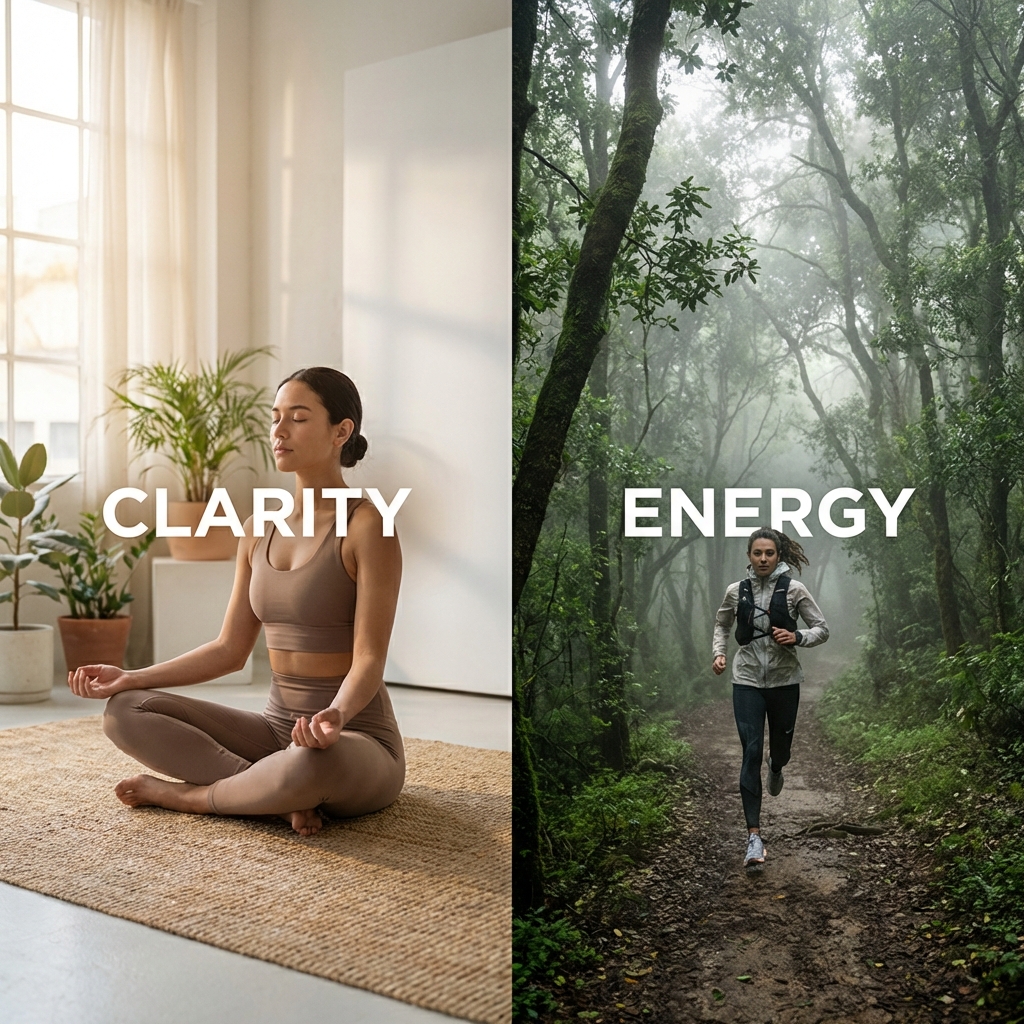
📊 Core Insights: Movement vs. Stillness
- Vitality Edge: 2024 data shows mindfulness is 12% more effective than self-chosen aerobic exercise for increasing feelings of "vitality" and serenity.
- Anxiety Regulation: Meditation consistently outperforms moderate exercise in reducing long-term psychosocial anxiety metrics.
- The Synergistic Effect: Combining both practices (meditation before or after exercise) reduces cortisol levels 20% more than either practice on its own.
- Physical Quality of Life: Exercise remains the superior choice for physical health-related quality of life, including metabolic and cardiac benchmarks.
In the wellness space, we are often presented with a choice: Do you need to "run it out" or "sit it out"? On one side, the high-energy advocate points to the "runner's high" and the immediate endorphin flood. On the other, the meditation expert cites neuroplasticity and the profound calm of the parasympathetic nervous system.
For a long time, we relied on personal anecdotes. But as we move into 2026, we finally have enough comparative data to stop guessing. The question isn't just "which is better," but "which is better for what?"
1. The Bio-Chemical Battle: Endorphins vs. GABA
To understand the mood impact, we have to look at the brain's "pharmacy." Exercise is primarily a top-down energy boost. When you engage in moderate-to-high intensity movement, your brain releases endorphins (natural painkillers) and dopamine (the reward chemical). Data from 2024 clinical reviews indicates that this response is nearly immediate, peaking within 20 minutes of activity.
Meditation takes a bottom-up approach. It primarily targets the HPA axis (hypothalamic-pituitary-adrenal), reducing cortisol—the primary stress hormone—and increasing GABA, a neurotransmitter that helps the brain "quiet down." While the endorphin spike from exercise is higher, the GABA increase from meditation tends to be more sustainable over a 24-hour period.
2. The "Vitality" Metric: A Surprising Find
A pivotal 2023-2024 study compared guided mindfulness practice with self-chosen aerobic exercise. While both improved general mood, the researchers found a distinct winner in the "Vitality" category. Vitality isn't just the absence of tiredness; it's a measurable state of being full of life and energy.
The data suggests that for Gen-Z and younger professionals facing "cognitive fatigue" (the feeling of being drained by screens), the stillness of meditation might actually be more recharging than the physical exertion of a workout. Exercise improves stamina, but meditation appears to preserve "cognitive battery."
3. The 2025 "Synergistic" Model: 1+1 = 3
Perhaps the most exciting shift in 2025 research is the move away from comparison toward combination. Recent longitudinal data shows that the best results for mental health aren't achieved by choosing one, but by sequencing them.
When individuals meditate for just 10 minutes before a workout, their perceived exertion decreases, and their post-workout "calm" lasts 30% longer. Conversely, meditating after a workout helps the body transition from the sympathetic state (fight or flight) to the parasympathetic state (rest and digest) much faster, improving physical recovery markers like Heart Rate Variability (HRV).
4. Which One Should You Choose Today?
Based on the aggregate data from 2024 and projected 2025 findings, here is the decision matrix:
- Choose Exercise if: You feel lethargic, "stuck" in a low-energy state, or need a physical health boost (cholesterol/blood sugar). It is the king of general emotional uplift.
- Choose Meditation if: You feel over-stimulated, anxious, or have racing thoughts. It is the gold standard for psychosocial well-being and life satisfaction.
- Choose Both if: You are dealing with chronic stress or burnout. The combined effect on cortisol reduction is mathematically superior to any single-modality intervention.
The Bottom Line
The data doesn't pick a winner because the human brain needs both. Exercise builds the machine, but meditation tunes the software. In a world that demands both high performance and deep resilience, the most "data-backed" routine is likely a 20-minute walk followed by 10 minutes of intentional stillness. Your mood isn't a single metric—it's a balance of energy and peace.