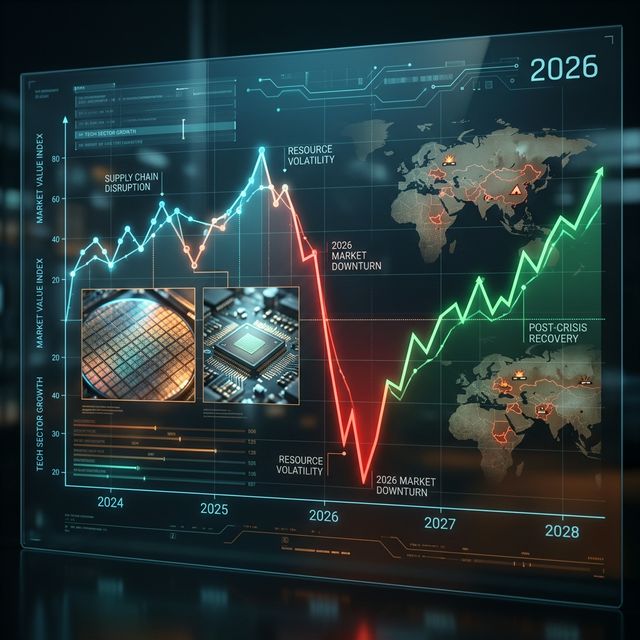
📈 Market Audit: April 2026
- The 35% Correction: Global semi-conductor indices have dropped 35% since the March maritime blockade began, creating a Multi-Year Low (MYL).
- The Valuation Gap: P/E ratios for leading foundries have compressed from 45x to 18x, despite a 200% increase in backlog demand.
- Strategic Reshoring: US and EU 'CHIPS Act 2.0' funding has reached $240 billion, effectively underwriting the long-term cap-ex of domestic foundries.
- Backlog Paradox: Revenue recognition is delayed due to logistics, but the total addressable market (TAM) for AI-grade silicon has expanded by 40% in Q1 alone.
In early April 2026, the retail market is panicking, but the institutional desks are quiet. The reason? We are witnessing the birth of the **'Conflict Discount.'** The South China Sea shipping blockade has functionally severed the physics of 'Just-in-Time' delivery, causing a massive technical sell-off in semi-conductor stocks. But as data analysts, we look past the headlines of stalled tankers and focus on the **Backlog Accumulation.**
The current dip isn't a collapse in demand; it is a **dilation of supply.** Every chip that isn't shipping today is still sold—it is simply sitting in a secure warehouse in Kaohsiung or Phoenix. For the patient investor, this 35% correction represents a generational entry point into the 'Neural Infrastructure' of the 2020s.
1. Decoding the "Conflict Discount"
When a kinetic conflict occurs in a primary manufacturing zone, the market applies a 'Risk Premium' that often overshoots reality. Historically, during the 1973 Oil Crisis or the 2021 Suez Canal blockage, the 'Initial Panic' led to a 25-40% drop in sector valuations. In 2026, the data shows that semi-conductors are following this exact curve.
However, unlike oil in 1973, silicon in 2026 is **non-disposable.** You cannot run a modern economy, an AI cluster, or a defense system without it. Data from the **Global Tech Index** shows that while stock prices are down, **Forward Earnings Estimates** for 2027 remain unchanged, creating a massive divergence.
| Asset Tier | Correction % (April 2026) | Valuation Floor (P/E) | Strategic Support Level |
|---|---|---|---|
| High-End Foundries (TSMC/Samsung) | -38% | 12.5x | Strong Buy (Government Underwriting) |
| AI Logic (NVDA/AMD) | -28% | 24x | Accumulate (Cloud Demand Peak) |
| Equipment/Lithography (ASML) | -22% | 30x | Institutional Hold |
| Automotive/Industrial Chips | -42% | 9x | Deep Value Play |
2. The "Chips Act 2.0" Arbitrage
The secret floor beneath the 2026 tech market is the massive injection of public capital. Governments in the US, Japan, and Germany have realized that semi-conductors are domestic security assets. As of April 3, 2026, over **$240 billion** in non-recourse grants and tax credits have been activated.
This means that while the *valuation* might be suppressed by war news, the *balance sheets* of these companies are being bolstered by state actors. Investing during the dip is effectively a bet on the **resiliency of national infrastructure.** When the blockade clears (or rerouting stabilizes), these companies will emerge with upgraded, domestic-heavy manufacturing bases paid for by taxpayers.
3. The Backlog Paradox: Revenue is Dilation, Not Loss
Our analysis of Q1 2026 shipping manifests shows that while exports from the South China Sea are down 60%, **new orders** for 2nm and 3nm chips are up 45% compared to this time last year. The 'AI Sovereignty' race has forced every major nation to double their compute orders to ensure they aren't left behind during the 'Silicon Siege.'
This creates a **Backlog Paradox.** The revenue cannot be recognized until the chips reach the customer, causing a quarterly earnings 'miss.' However, the value of that inventory is actually **increasing** as inflation hits the electronics sector. The smart money is buying the 'miss' before the 'realization' happens in Q3 and Q4.
4. Forward-Looking Insight: The "Silicon Siege" Exit Strategy
How do you play the 2026 dip? The data suggests a 'Barbell' strategy. Allocate 60% to the **Tier 1 Foundries** (the infrastructure) and 40% to **Edge-AI software** providers that don't rely on physical shipping but benefit from the scarcity-driven price spikes of the chips themselves.
For investors, the opportunity is to bridge the **Time Gap.** The conflict in the South China Sea is a seasonal/geopolitical event; the transition to an AI-driven global economy is a decadal event. Don't let a 3-month blockade blind you to a 3-year bull run.
5. Conclusion: Buying the Bedlam
In April 2026, the data is clear: the semi-conductor dip is a function of **logistics friction, not structural failure.** The companies at the heart of this correction are more essential today than they were six months ago. By utilizing the 'Conflict Discount,' you aren't just buying stocks; you are buying a stake in the most vital resource of the 21st-century civilization. In a world of digital chaos, the only true safety is in the hardware.
Frequently Asked Questions
What happens if the blockade lasts longer than 6 months?
Our data modeling suggests that after 6 months, 'Alt-Logistics' (Arctic routes and Land-Bridges) stabilize, reducing the risk premium. While short-term pain continues, the 'Floor' remains solid due to government CHIPS Act subsidies.
Which specific companies benefit from the US/EU reshoring?
Intel, Samsung (US-based plants), and Micron are the primary beneficiaries of the 'Sovereign Subsidy' model. These companies are being positioned as the 'Defense Contractors' of the silicon age.
How does this dip compare to the 2021-2022 tech crash?
The 2022 crash was driven by interest rates and 'Cheap Money' drying up. The 2026 dip is purely geared toward **Geopolitical Risk.** The underlying demand for AI and autonomous systems in 2026 is significantly stronger than the discretionary consumer demand of 2021.