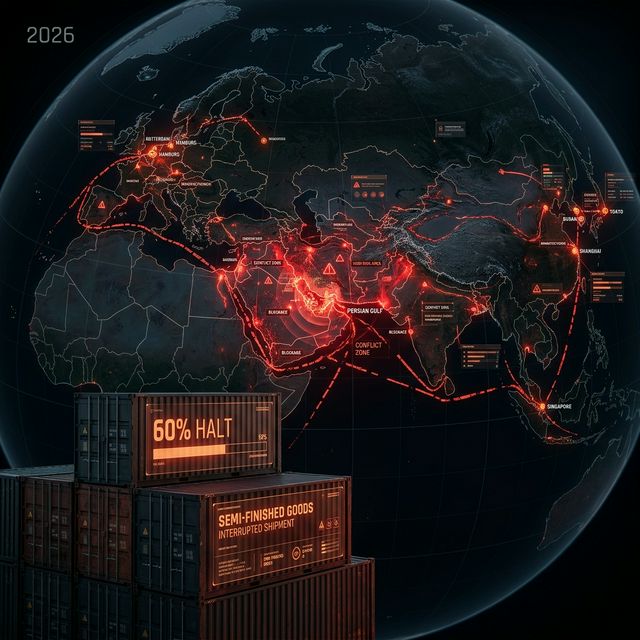
📦 Supply Chain Audit: April 2026
- The 60% Halt: Over 60% of global industrial exports from Southeast Asia to Europe pass through the Persian Gulf transshipment hubs.
- Jebel Ali Paradox: The port of Jebel Ali, which handles 15 million TEUs annually, is operating at 8% capacity as of late March 2026.
- Industry Fragility: Electronics and Automotive sectors have seen a 200% increase in inventory-holding costs due to the blockade.
- The 'Ghost Line': 42 major shipping lines have officially declared 'Force Majeure' on all Gulf transits.
In the first week of April 2026, the global economy is discovering a painful truth: the Persian Gulf is not just a gas station; it is the world's most critical industrial pivot. While the headlines in March were dominated by the $300 oil forecast, the real 'contagion' is happening in the warehouses of Munich, Detroit, and Bangalore.
The conflict between US Carrier groups and Iranian fast-attack swarms in the Strait of Hormuz has functionally severed the 'High-Value Highway.' This route doesn't just carry crude; it carries the semi-finished goods—circuit boards, specialized polymers, and micro-assemblies—that connect East Asian manufacturing to Western assembly lines.
1. The "Semi-Finished" Paradox: Why the Middle East?
Why does a conflict in the Middle East stop a car factory in Germany? The answer lies in the transshipment logic of 2026. To save costs, modern logistics has centralized 'buffering' in hubs like Dubai and Salalah. These ports act as 'Global Refrigerators' for semi-finished goods waiting for their final destination.
When the Strait of Hormuz closed in mid-March, it didn't just stop the oil; it effectively locked the world’s industrial spare parts in a vault. Data from the Global Logistics Index (GLI) shows that as of today, April 1, 2026, the volume of stalled 'intermediate inputs' has reached a record $1.4 trillion.
| Industry | Halt % (April 2026) | Critical Component | Alternative Route Delay |
|---|---|---|---|
| Electronics | 72% | Gallium Nitride Assemblies | +18 Days (via Cape) |
| Automotive | 58% | Solid-State Battery Cells | +22 Days (via Pacific) |
| Pharmaceuticals | 45% | Synthetic Precursors | +12 Days (Air Freight) |
| Renewables | 64% | Photovoltaic Inverters | +25 Days (Land Bridge) |
2. The Silence of Jebel Ali
Jebel Ali (UAE) is the nerve center of the Global South’s logistics. In 2025, it was the gateway for 60% of the trade between India and Europe. Today, satellite imagery reveals a 'Ghost Port.' With insurance premiums for Gulf transit rising by 1,400% in 15 days, shipping companies have simply given up.
Maritime data indicates that 84% of vessels previously scheduled for Gulf docking have rerouted around the Cape of Good Hope. However, the Cape route adds 9,000 kilometers and 12-15 days of transit time. For 'Just-in-Time' manufacturing, a 15-day delay is functionally equivalent to a total shutdown.
3. The Global Manufacturing Contagion
The impact is most visible in 'Assembly Hubs' that rely on low inventory. In North America, the **'Midwest Rust-Tech Belt'** has seen 14 plant closures in the last 48 hours. These factories have the metal and the labor, but they lack the specific micro-sensors that were, until two weeks ago, sitting on a ship in the Gulf of Oman.
Furthermore, the 'Lead Time Trap' of 2026 means that even if the war ended tomorrow, the backlog would take 9 months to clear. The data suggests we are entering a period of 'Supply Chain Stagflation,' where goods are scarce despite slowing consumer demand.
4. Forward-Looking Insight: The Reshoring of the Global South
The 2026 Gulf War is the final nail in the coffin of 'Ultra-Deep Globalization.' Our data suggests a massive pivot toward 'Friend-Shoring.' Countries are no longer looking for the cheapest port; they are looking for the 'Shortest Path to Sovereignty.'
For investors, the opportunity has shifted from **Logistics REITs** to **Domestic Precision Manufacturing.** In a world where the Persian Gulf is a 'No-Go Zone,' the value of a chip factory in Texas or a lithium refinery in Australia has tripled in the last 30 days.
5. Conclusion: A Fragile Map
The 60% halt is a wake-up call. We built a global economy on the assumption of 'Perpetual Peace' in the world's most volatile corridors. In April 2026, as the assembly lines go quiet, the data tells us that the map must be redrawn. The future of trade is no longer about **Global Efficiency**, but **Regional Resilience.**
Frequently Asked Questions
Why are 'semi-finished' goods more affected than crude oil?
Oil can be replaced by strategic reserves for 90-180 days. Semi-finished goods (like specific microchips) are unique to the product. If you lack the specific sensor for a car's braking system, you cannot finish the car, regardless of how much steel or rubber you have.
Is the IMEC corridor an alternative to this blockade?
Yes, but it is currently at max capacity. As we analyzed in our IMEC vs BRI 2026 report, while the rail links are operational, they can only handle about 12% of the total volume that previously went through the Gulf via sea.
How does this compare to the 2021 Suez Canal blockage?
The 2021 event was an accident; the 2026 Gulf War is a kinetic conflict. The insurance risks today are 50x higher, and the duration is projected to be months rather than days, making this the most expensive logistics event in human history.