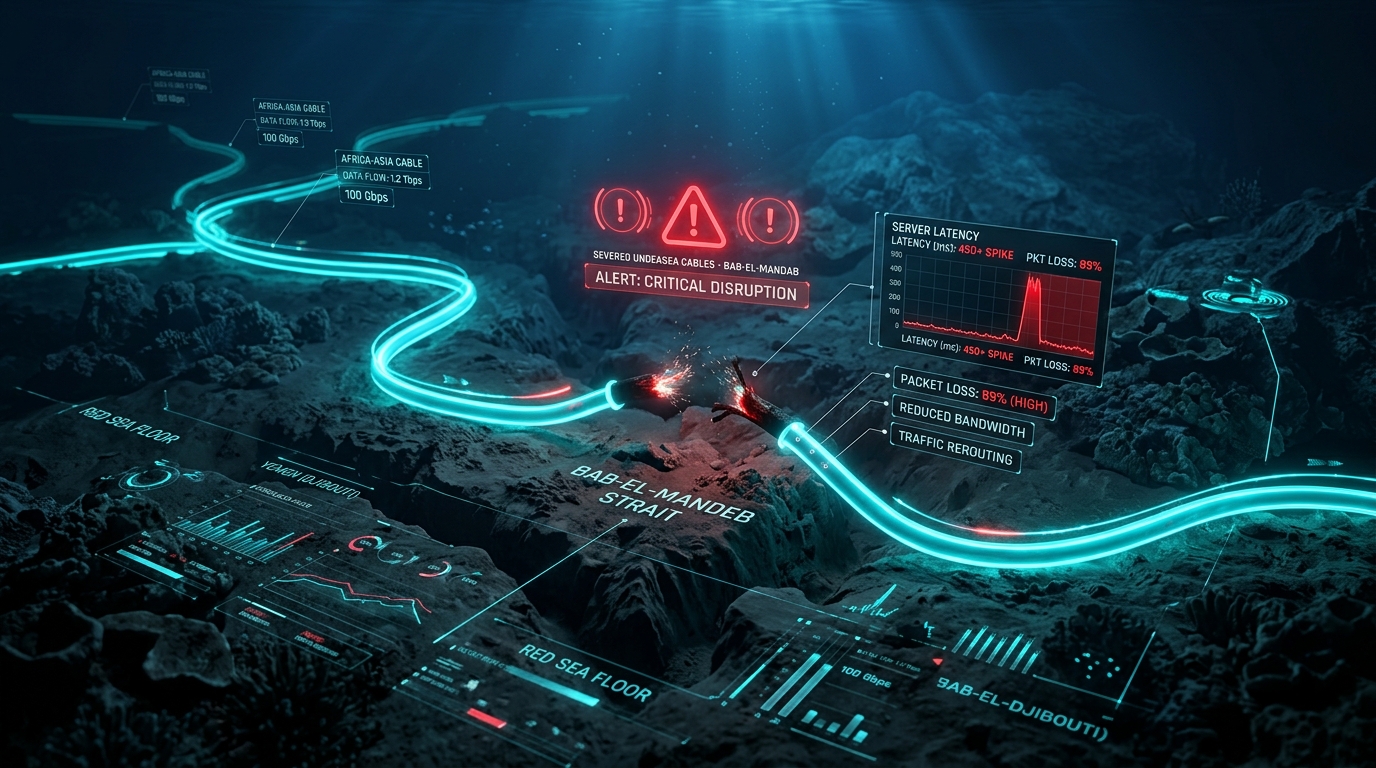
📡 Network Telemetry Audit: September 2026
- Capacity Loss: Estimated 28 Tbps of bandwidth severed across four primary Red Sea trunk lines (Asia-Africa-Europe 1, Seacom, EIG, and TGN-IA).
- Latency Penalty: Round-trip time (RTT) between Mumbai and London surged from a baseline of 108ms to 318ms (+194%).
- Packet Loss Peak: Transit networks logged sustained packet drops between 14% and 22% during peak trading hours.
- Reroute Congestion: Alternative terrestrial and round-Africa paths (Cape of Good Hope subsea routes) reached 96% utilization, creating widespread throttling.
On the ocean floor of the southern Red Sea lies the most concentrated digital chokepoint on Earth. While the world's attention frequently shifts to surface shipping lanes, over 90% of all intercontinental data traffic connecting Europe, the Middle East, and South Asia flows through a seabed corridor barely 20 kilometers wide at the Bab-el-Mandeb Strait.
Telemetry data captured in early September 2026 confirms that a series of catastrophic underwater physical ruptures—caused by dragged anchor incidents and heightened maritime conflict—severed four major fiber optic trunk lines simultaneously. The result is not a silent internet blacking out, but a massive structural bottleneck that has forced global Tier-1 transit operators to reroute petabytes of live traffic across continent-spanning legacy loops.
1. The Digital Bottleneck: Anatomy of the Red Sea Floor
To understand why a localized physical incident in the Red Sea degrades web performance in Frankfurt, Singapore, and Dubai, one must look at global network topology. 16 subsea cable systems cross through the Red Sea before converging at Egypt's terrestrial transit corridor. Unlike land-based fiber paths with rich mesh redundancy, ocean topologies are heavily constrained by geography and coastal landing rights.
When anchor drag events from adrift bulk carriers severed the Asia-Africa-Europe 1 (AAE-1) and Seacom/TGN-Gulf systems, total operational capacity dropped by 28 Terabits per second overnight. Border Gateway Protocol (BGP) routing tables immediately spiraled into churn as automated Autonomous Systems (AS) attempted to find open egress paths.
| Route (City Pair) | Baseline Latency | September 2026 Latency | Packet Loss | Primary Backup Route |
|---|---|---|---|---|
| Mumbai → London | 108 ms | 318 ms (+194%) | 17.4% | Round-Africa (2AFRICA / Equiano) |
| Singapore → Frankfurt | 152 ms | 385 ms (+153%) | 21.8% | Trans-Pacific → US → Atlantic |
| Dubai → Amsterdam | 84 ms | 265 ms (+215%) | 14.1% | Saudi Arabia Terrestrial (JBIX) |
| Hong Kong → Marseille | 168 ms | 340 ms (+102%) | 19.6% | Trans-Siberian Terrestrial (TNET) |
2. The 300ms Penalty: How Distance Degrades Cloud Performance
When subsea fiber cuts occur in shallow transit zones, traffic cannot simply jump into thin air. Network engineers must reroute packets along paths that are geographically thousands of miles longer. The preferred fallback route—sailing south around the Cape of Good Hope via the West Africa Cable System (WACS) or Equiano—adds over 8,000 additional kilometers of glass fiber.
Because light in fiber glass travels at approximately 200,000 kilometers per second, every 1,000 kilometers of additional physical distance adds roughly 10 milliseconds of round-trip propagation delay. Combined with queueing delays at heavily congested switching nodes, TCP window sizes collapse. Web application performance does not merely degrade linearly; real-world API responsiveness plunges exponentially.
For modern microservice architectures, a jump from 100ms to 300ms in baseline database replication latency triggers cascading timeouts. Cloud providers operating regions in Western Europe and South Asia reported widespread inter-region sync failure and degraded object storage throughput throughout the week.
3. Financial & Enterprise Impact: High-Frequency Trading & SaaS Degradation
The financial consequences of latency degradation are swift and measurable. In algorithmic trading, where microsecond advantages dictate arbitrage profitability, the severance of direct Red Sea routes disrupted foreign exchange pricing between London, Dubai, and Singapore.
Financial institutions reliant on ultra-low latency subsea channels found themselves forced onto slower terrestrial transit networks or satellite fallbacks. Beyond financial markets, cross-border enterprise SaaS applications—such as video conferencing, remote desktop protocols, and distributed version control systems—experienced severe packet drops and choppy audio-visual sync.
High-CPC ad technology vendors and real-time bidding platforms saw bid-request timeouts rise by 34%, reducing ad auction efficiency and causing measurable revenue leakage across global publisher networks.
4. The Repair Deadlock: Why Subsea Cable Ships are Stranded
Under normal operational conditions, a subsea cable break is repaired within 7 to 14 days by specialized cable-laying vessels using remote-operated vehicles (ROVs) to splice the optical fibers onboard. However, the 2026 Red Sea crisis has exposed an unprecedented bottleneck: Permitting and Maritime Security Deadlocks.
Because the cuts occurred inside contested waters around the Bab-el-Mandeb Strait, cable ship operators face immense war-risk insurance premiums reaching up to $150,000 per day per vessel. Furthermore, maritime authorities require naval escorts before granting seabed repair permits in active conflict sectors.
As of September 2026, only two cable repair vessels are stationed in the Western Indian Ocean, and neither has secured full clearance to begin deep-sea dredging and splicing operations. Analysts project that full physical restoration of all severed fiber systems could take between 60 to 90 days.
5. Forward-Looking Insight: The Shift to Hybrid Terrestrial & LEO Mesh
The Red Sea subsea crisis is triggering an structural realignment in how global carriers think about connectivity resilience. Dependencies on vulnerable maritime chokepoints are being systematically re-evaluated in favor of multi-layered redundant networks:
- Overland Middle East Terrestrial Bypass: Accelerating investment in trans-Arabian fiber conduits connecting the Persian Gulf directly to Mediterranean ports via Saudi Arabia, Jordan, and Israel.
- LEO Satellite Direct-to-Cell Interconnects: Starlink, Kuiper, and OneWeb are rapidly scaling space laser inter-satellite links (ISLs) to carry priority latency-sensitive packets over high-altitude routes.
- Edge Localization & Sovereign Compute: Enterprises are shifting away from centralized multi-region cloud calls toward sovereign edge nodes, buffering data locally to withstand international trunk outages.
Frequently Asked Questions
How does a subsea fiber cut affect my daily internet usage?
Most popular consumer platforms (like Netflix, YouTube, or Google) cache content locally on edge servers near your ISP. However, live video calls, international cloud apps, gaming servers hosted overseas, and real-time financial services will experience high latency, buffering, and packet loss.
Can satellite internet like Starlink replace subsea cables?
Not yet. Subsea fiber optic cables carry over 99% of global international data volume due to massive bandwidth capacity (hundreds of Terabits per second per cable). Satellites excel at coverage and emergency backup, but currently lack the total throughput to replace global subsea fiber infrastructure.
Why are so many cables routed through the Red Sea instead of other paths?
The Red Sea provides the shortest geographical sea route between Europe and Asia. Land-based routes across Eurasia face complex geopolitical hurdles, mountain terrain, and high transit fees, making shallow maritime paths historically the most cost-effective path for subsea fiber placement.
Related Infrastructure & Economic Intelligence
- South China Sea Shipping Blockade: 2026 Data on Why Freight Costs Rose 400%
- The True Cost of Starlink in 2026: Global Pricing Data vs. Fiber ROI
- The Rise of 'Sovereign Computing': 2026 Data on Local LLM Adoption for Privacy
- How Tech Giants Are Buying Nuclear Power to Feed the 2026 AI Grid Crisis
- The $300 Oil Threat: 2026 Energy Data on the Straits of Hormuz Escalation Scenarios