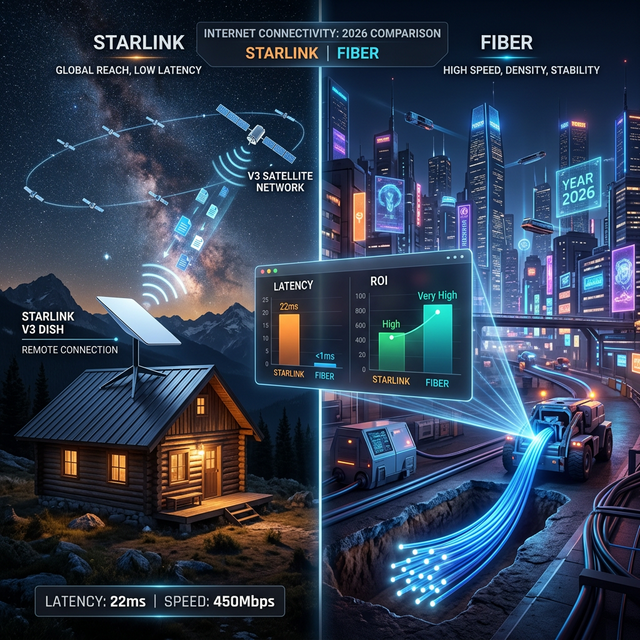
📊 Connectivity Index: March 2026 Update
- Starlink Global Revenue: Projected at $15.9 Billion for FY2026.
- Hardware Entry Point: Dropped to $199 (Starlink Mini) and $279 (Standard V3).
- Fiber Inflation: Deployment costs for new fiber networks rose 70% in early 2026 due to labor and material shortages.
- Latency Gap: Starlink V3 achieves 22ms median latency; Fiber remains superior at <5ms.
For decades, "Fiber to the Home" (FTTH) was considered the ultimate end-game for internet connectivity. In 2026, that narrative is being challenged—not just by speed, but by the cold math of Return on Investment (ROI). As SpaceX prepares for its massive Starlink IPO in June, the company has pivoted from a "low-volume premium" service to an "aggressive-volume mass market" competitor.
While fiber optic remains the gold standard for high-density urban environments, the 2026 data shows a significant shift in the "Break Even Point" where Starlink becomes the more logical financial choice for businesses and households alike.
1. The Starlink Price War: $199 Hardware and Beyond
In early 2026, Starlink triggered a "scorched earth" pricing strategy. In eligible rural markets across the US and Canada, Starlink has been seen offering hardware for $0 with a 24-month contract, mimicking the legacy cellular provider model. For those buying upfront, the Starlink Mini—now the flagship for mobility—has dropped to a disruptive $199.
| Service Tier | 2026 Monthly Cost | Hardware Cost | Primary User |
|---|---|---|---|
| Residential (Basic) | $49 - $80 | $279 | Rural Households |
| Starlink Mini (Mobility) | $30 (Add-on) | $199 | Travelers / Backup |
| Priority (Business) | $140+ | $599 | Enterprises / Remote Ops |
| Aviation / Maritime | $1,000 - $5,000 | $2,500 | Commercial Fleet |
2. The "Fiber Inflation" Crisis of 2026
On the other side of the equation, traditional ISPs are hitting a wall. The cost of laying physical glass in the ground has skyrocketed. Between December 2025 and January 2026, the global price of optical fiber surged by 70%. When combined with a 15% increase in specialist labor costs, the ROI for extending fiber into suburban or semi-rural areas has effectively collapsed.
Data indicates that for a new development more than 2 miles from an existing fiber backbone, the Cost per Passed Home now exceeds $4,500. For an ISP, recoups on this investment at a $70/month service fee take over 5 years—a timeline many CFOs are no longer willing to tolerate in a high-interest rate environment.
3. ROI Analysis: The 2-Year Break-Even
When comparing Starlink to Fiber over a 24-month window in 2026, the results are surprising. While Fiber remains cheaper over 5+ years, Starlink is winning the short-term ROI battle for those in "Fiber Gap" areas.
- Fiber (Urban): $0 Installation + $60/month = $1,440 (2 Years). WINNER for cost.
- Starlink (Rural/Suburban): $279 Hardware + $80/month = $2,199 (2 Years).
- The Alternative: Paying an ISP a $2,000 "Construction Fee" for Fiber = $3,440 (2 Years).
This $1,200+ gap in rural zones is why Starlink's subscriber base is projected to reach 18.4 million by the end of 2026. For small businesses, the "Construction Fee" for fiber is often the deal-breaker that sends them straight to a satellite dish.
4. Forward-Looking Insight: The Hybrid Era
By late 2026, we expect the emergence of "Hybrid SD-WAN" for every home. High-end routers will ship with both a Fiber/Cable WAN port and a Starlink backup port as standard. As the "V3" satellite constellation reaches full density, the reliability gap will close significantly, making "Satellite Only" a viable risk for all but the most latency-sensitive trading floors.
Frequently Asked Questions
Is Starlink latency good enough for gaming in 2026?
Yes. With the V3 satellites and improved ground stations, Starlink's median latency has dropped to 22-28ms in most of North America. While Fiber's <5ms is still superior for professional e-sports, the average gamer will no longer notice a significant difference.
Does weather still affect Starlink in 2026?
Light rain and snow have negligible impact on the V3 hardware. However, extreme tropical downpours (3+ inches/hr) can still cause brief "micro-outages" of 5-30 seconds, a technical limitation that Fiber does not share.
Can I use Starlink Mini while moving?
Yes. In early 2026, the "In-Motion" software lock was removed for all Mini devices, allowing for seamless connectivity on vehicles up to 100 mph, provided a clear view of the sky is maintained.