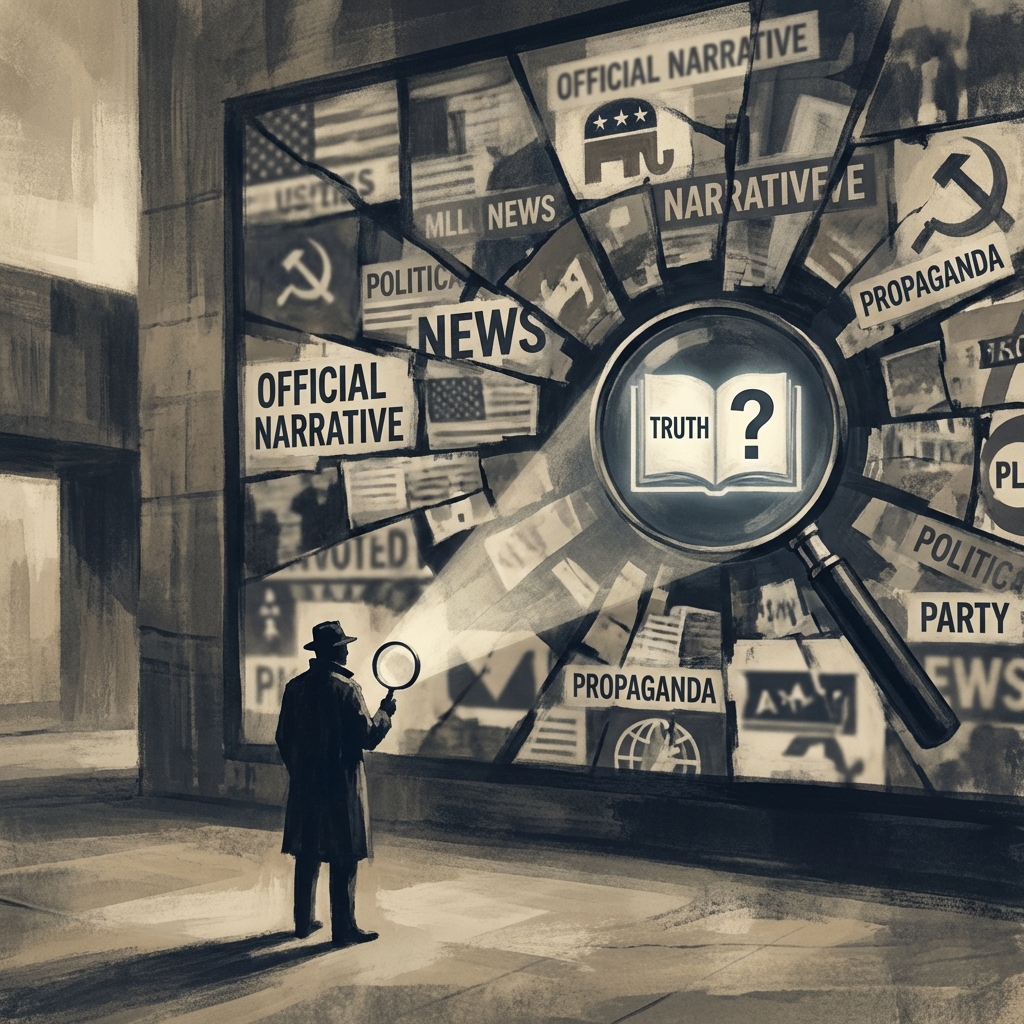
📊 The Reality of Information Intake
- Daily Data Consumption: On average, humans consume 34GB of information daily.
- Echo Chambers: Approximately 60% of social media users are rarely exposed to opposing views.
- Economic Impact: Misinformation costs the global economy $78 billion annually.
- Trust Index: Historical data shows a 30% decline in institutional trust over the last decade.
Think about the last time you saw a headline that made your blood boil. Or perhaps one that confirmed exactly what you already thought about a "rival" political figure. Our first instinct is usually to hit 'share' or 'like'. But in that split second, we stop being citizens and start being amplifiers.
In the digital age, your attention is the most valuable currency in politics. When we stop questioning the narratives handed to us, we lose the ability to think independently. Questioning isn't about being a rebel or an agitator; it's about being an informed consumer of the democracy you live in. It is a fundamental civic skill, as essential as voting itself.
1. The Information Overload Era: Why We Stop Questioning
The sheer volume of information we process today is unprecedented. Data suggests the average person consumes the equivalent of 34 gigabytes of data every single day. In the political sphere, this often manifests as "narrowcasting"—where algorithms feed us exactly what we want to hear, based on our previous engagement.
A recent study found that 60% of social media users rarely see content that challenges their existing political views. This "echo chamber" effect makes any questioning feel like a betrayal of our "side." When every piece of information we see reinforces our bias, the very act of asking "Is this true?" feels like an act of rebellion against our community. In reality, it is the only way to escape the algorithmic loop.
2. Questioning vs. Rebellion: Finding the Balance
There's a common misconception that to question a political narrative is to be "anti-system." In reality, the most robust systems are those that are constantly scrutinized. In a healthy democracy, questioning is a feature, not a bug. It ensures accountability and prevents the normalization of misinformation.
It's important to distinguish between "cynicism" and "skepticism." A cynic believes everything is a lie; a skeptic asks for evidence before believing it is true. Being a skeptic is the difference between saying "I hate this policy" and asking "Does this policy actually solve the problem it claims to?" One is an emotional reaction; the other is a civic inquiry. The latter is what builds better societies.
3. The High Cost of Blind Belief
When narratives go unchecked, the consequences are measurable and severe. Misinformation isn't just a nuisance; it's an economic burden. Research estimates that misinformation costs the global economy an staggering $78 billion annually, affecting everything from stock market stability to public health outcomes.
Beyond the financial cost, blind belief erodes social trust. Data from the Edelman Trust Barometer shows that trust in government and media is at historic lows, yet the belief in polarizing narratives remains at an all-time high. This paradox exists because we trust our "tribal" narratives more than neutral facts. By choosing to question, we reduce the power of divisive rhetoric and force our leaders to provide substance over slogans.
4. The Civic Skill Checklist: How to Question Effectively
How do you practice "healthy skepticism" without becoming overwhelmed or cynical? It requires a structured approach to information consumption:
- Follow the Money: Ask who benefits from you believing this specific narrative. Is there a financial or political gain for the source?
- Check the Primary Source: Don't rely on summaries. If an article cites a "new study," go find the study and read the abstract yourself.
- Seek the Counter-Argument: What is the strongest possible argument against what you just read? If you can't find one, you're likely in an echo chamber.
- Acknowledge Your Own Bias: Recognize that your brain is hardwired to want to believe things that make your "team" look good and the "other team" look bad.
Looking Ahead: From Passive Recipient to Active Citizen
Independence of thought is the ultimate act of citizenship. In a world where billions are spent to control the narrative, the simple act of asking "Why?" is revolutionary. By choosing to question, you aren't just protecting yourself from misinformation; you're helping build a more resilient and honest society.
The next time a political narrative feels a bit too perfect, or a bit too convenient, take a breath. Don't hit 'share' immediately. Ask a question. Look for the data. Your democracy isn't built on blind loyalty; it's built on the collective intelligence of people who refuse to be told what to think.
Frequently Asked Questions
How can I tell if a political narrative is biased?
Look for overly emotional language, a lack of verifiable citations, and "us vs. them" framing. If a narrative suggests there is only one "right" way to see a complex issue, it is likely biased.
Is questioning narratives the same as being a conspiracy theorist?
No. Healthy skepticism is based on seeking evidence and being open to new facts. Conspiracy theories often rely on ignoring evidence or creating unsolvable "shadow" scenarios that cannot be proven or disproven.
Where can I find neutral data to verify claims?
Look for non-partisan research organizations such as Pew Research Center, academic journals, or official government data repositories like the Census Bureau or the World Bank.
Does questioning narratives make me less loyal to my party?
On the contrary, questioning makes you a more valuable member of any group. It prevents groupthink and ensures that the policies you support are actually effective and based on reality.