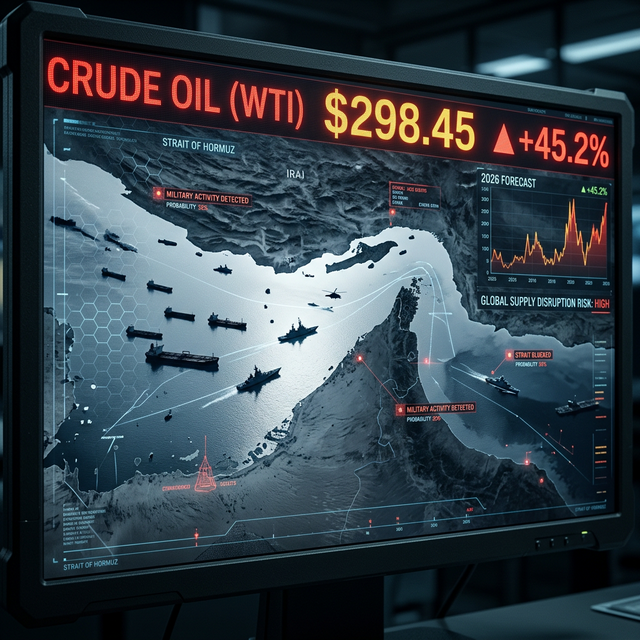
📊 Strategic Oil Assessment: March 2026
- Volume at Risk: Approximately 21 million barrels per day (mbpd) pass through the Strait of Hormuz.
- Current Price Shock: Brent Crude jumped from $67 to $94 in the 24 hours following the strikes.
- Tanker Gridlock: 150+ VLCCs (Very Large Crude Carriers) have dropped anchor outside the Gulf of Oman.
- Supply Buffer: Global strategic reserves are at their lowest levels in 15 years, reducing the ability to absorb a long-term shock.
On February 28, 2026, the world woke up to a new geopolitical reality. The US-led "Operation Epic Fury," targeting Iranian military infrastructure, has not only decapitated significant portions of the IRGC command but has also effectively turned the Strait of Hormuz—the world's most vital energy artery—into a militarized dead-zone. For the global economy, the question is no longer "if" oil will rise, but "where" the ceiling lies.
As of March 1, our data indicates a unprecedented level of market volatility. While prices around $100 were anticipated, a prolonged closure of the Strait could trigger a "Hyper-Price Scenario" previously discarded by major financial institutions as a low-probability tail risk.
1. The $100 Billion Chokepoint: Why Hormuz Matters
The Strait of Hormuz is barely 21 miles wide at its narrowest point. Yet, through this tiny passage flows 20-30% of the world's total petroleum liquids and nearly 25% of global liquefied natural gas (LNG). In 2025, an average of 21 million barrels passed through daily. The immediate threat of Iranian retaliation against tankers has effectively halted commercial traffic.
| Scenario | Daily Supply Loss | Estimated Price (2026) | Economic Phase |
|---|---|---|---|
| Minor Disruptions (2 Weeks) | 2-3 Million Barrels | $105 - $115 | Manageable Inflation |
| Partial Blockade (1 Month) | 8-10 Million Barrels | $140 - $180 | Global Recession Risk |
| Full Closure (3+ Months) | 21 Million Barrels | $240 - $300 | Systemic Economic Collapse |
2. Why $300 Oil is No Longer Science Fiction
Traditional economic models struggle with supply shocks of this magnitude. Unlike the 1973 oil crisis, the global economy of 2026 is hyper-connected and relies on "just-in-time" logistics. If 21 million barrels are removed from the market overnight, the resulting bidding war for remaining supply (primarily from US shale, Canada, and Nigeria) will lead to an exponential price curve.
Energy analysts are now looking at the "Refinery Crisis". Most Asian refineries (Japan, South Korea, China) are structurally tuned to the specific grades of crude coming from the Gulf. A switch to Atlantic basin crude isn't just a matter of price—it's a technical impossibility for many facilities, leading to a simultaneous shortage of gasoline and jet fuel.
3. The Global Fallout: From Pump to Plate
Energy prices are the foundation of all other costs. At $300 oil, the cost of nitrogen-based fertilizers—primary inputs for global grain production—would triple. We project that a sustained oil price above $150 would add 8.5% to global food inflation within six months.
For the average consumer in the US and Canada, $300 crude would translate to gasoline prices exceeding $12.00 per gallon. This is not just a "high cost of living" issue; it is a fundamental threat to the logistics networks that sustain modern life.
4. Forward-Looking Insight: The Energy Pivot
Every crisis accelerates an existing trend. The 2026 Hormuz Crisis will likely be remembered as the final catalyst for the "Great Decoupling" from fossil fuels. Nations that have invested heavily in nuclear and domestic renewables are finding their currencies and economies significantly more resilient in this new "War Economy" era.
For investors, the message is stark: Volatility is the new baseline. Safe-haven assets like gold are already reflecting this, but the real play for 2026 is in energy infrastructure that bypasses the Middle East entirely.
Frequently Asked Questions
Is there an alternative route for Gulf oil?
Partially. Saudi Arabia and the UAE have pipelines that bypass the Strait, but their combined capacity is less than 6.5 million barrels per day—leaving 15 million barrels with no way out if the Strait is closed.
How long can the US Strategic Petroleum Reserve (SPR) last?
As of March 2026, the SPR is at roughly 350 million barrels. If the US were to release 1 million barrels a day to offset the shock, it would provide a buffer for about a year, but it cannot replace the total volume lost from the global market.
Will EVs help mitigate the oil price shock?
Yes, but the impact is limited. While EV adoption has reached 18% in some regions, the global logistics, shipping, and aviation sectors remain 95% dependent on petroleum. The "last mile" of the economy is still very much powered by oil.