📈 2026 Energy Infrastructure Snapshot
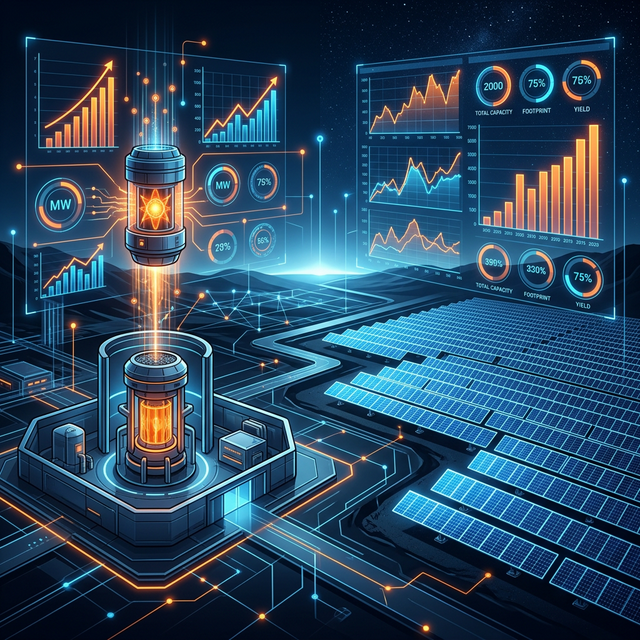
- The Capital Shock: First-of-A-Kind (FOAK) SMRs are currently clocking in at roughly $8,500 to $10,000 per kilowatt (kW) installed, compared to roughly $1,100 for utility-scale solar.
- The Capacity Factor Reality: SMRs run at a 93%+ capacity factor (24/7 reliable power). Solar, even in peak sun belts, averages around 24%. You need vastly more solar to equal one SMR's output.
- The Land Constraint: A 300 MW SMR fits on about 10-15 acres. A solar farm generating the equivalent *megawatt-hours* (accounting for capacity factor) requires upwards of 2,000 acres.
- The AI Catalyst: Tech giants backing SMRs aren't doing it for carbon credits; they are doing it because hyperscale AI data centers cannot afford the intermittency of the sun.
⚡ Related Grid Infrastructure Intelligence
Analyze how hyperscalers and EV fleets are straining global power grids:
For the last decade, the debate over the future of energy had unofficially crowned a winner. Solar and wind, subsidized by aggressive governmental policies and riding an astonishing cost-curve decline, were deemed the undisputed kings of the grid. Nuclear energy was largely viewed as an expensive, cumbersome relic of the 20th century, plagued by multi-billion dollar cost overruns like the Vogtle project in Georgia.
But the narrative in 2026 is rapidly shifting. A seemingly unstoppable force—the exponential power demand of Artificial Intelligence data centers and the electrification of grid infrastructure—is colliding with an immovable object: the limits of intermittent power.
Enter the Small Modular Reactor (SMR). Heralded as the agile, mass-producible savior of baseload power, SMRs are stepping into the ring against utility-scale solar. But when we strip away the Silicon Valley hype and the renewable lobby rhetoric, what do the actual 2026 cost data and ROI metrics reveal about this clash of titans?
1. The Immediate Hurdle: Upfront Capital Costs (CapEx)
If we look purely at the sticker price of installation, solar remains the undisputed champion of cheap capacity. Decades of manufacturing scale—largely driven by continuous output from Chinese supply chains—have pushed the Levelized Cost of Energy (LCOE) for utility-scale solar to historic lows.
In early 2026, building a 100 Megawatt (MW) utility-scale solar farm costs approximately $1.10 million to $1.25 million per MW installed. It is fast, proven, and financially modeled to near perfection by Wall Street project financiers.
SMRs, conversely, are currently getting battered on initial capital expenditure. Because the industry is still building "First-of-A-Kind" (FOAK) models rather than enjoying the economies of mass production, the data is sobering. Recent 2025/2026 financial models and project updates show SMRs costing between $8,500 and $10,500 per kW (or $8.5M to $10.5M per MW).
2. The Great Equalizer: Capacity Factor and "Firm" Power
If SMRs are eight times more expensive to build, why are Microsoft, Google, and Amazon aggressively signing Power Purchase Agreements (PPAs) with nuclear startups in 2026? The answer requires understanding the difference between "Nameplate Capacity" and "Capacity Factor."
When you build a 100 MW solar plant, it does not generate 100 MW continuously. In regions like the American Southwest, an excellent solar facility might achieve a 24% to 26% capacity factor. It generates nothing at night and sees reduced output during winter or storms.
Nuclear power operates with a 92% to 94% capacity factor. It provides what grid operators call "firm, dispatchable baseload." Therefore, to generate the same total *amount of raw electricity* (Megawatt-hours) annually as a 300 MW SMR, you would need to build roughly 1,100 MW to 1,200 MW of solar capacity.
And you still have a massive problem: The solar only works during the day.
3. The Battery Storage Penalty for Solar
To make solar mimic the 24/7 reliability of a nuclear reactor—a requirement for hyperscale AI data centers that operate continuously—you must pair it with colossal Battery Energy Storage Systems (BESS), typically lithium-ion megawatt-scale arrays.
When you add the cost of 4 to 8 hours of battery storage required to smooth out solar intermittency, the Levelized Cost of Energy (LCOE) for "Firm Solar" skyrockets. The 2026 data indicates that Solar + Long-Duration Storage often pushes the true cost of generating reliable, round-the-clock power remarkably close to—and sometimes higher than—the projected "Nth-of-A-Kind" (NOAK) target costs for mature SMR manufacturing.
4. The Real Estate Bottleneck (The Land Data)
Perhaps the most severe constraint facing utility-scale solar in 2026 isn't the cost of the panels; it's the cost, and availability, of the dirt beneath them.
Energy density is the trump card of nuclear physics. A standard 300 MW Small Modular Reactor facility requires a footprint of approximately 10 to 15 acres. Because of passive safety systems and smaller exclusion zones, they squeeze massive energy output into a tiny geographic box.
To match that output with a firm Solar + Storage array, developers need to acquire, permit, and transmission-connect upwards of 2,000 to 2,500 acres. In 2026, finding 2,000 continuous, cheap, un-contested acres near major transmission lines or data centers is becoming an aggressive, multi-year legal battle against local opposition (often termed "NIMBYism").
The 2026 Verdict: Horses for Courses
The data paints a clear, bifurcated picture rather than declaring an absolute victor. Small Modular Reactors are currently in their "Model T" phase—expensive to prove, hard to license, and suffering from massive initial capital costs. However, they are rapidly becoming the preferred premium fuel for off-grid industrial applications and tech giants whose multi-billion dollar AI infrastructure demands absolute density and reliability.
Utility-scale solar remains the undisputed king of cheap, daytime generation for the broader grid. It is the tactical play for lowering daytime wholesale electricity prices. But as the grid demands more *reliable* hours, the cost advantage of solar evaporates into lithium-ion storage fees and massive land acquisitions, laying the groundwork for the SMR renaissance we are mapping today.
Frequently Asked Questions
Are SMRs commercially available right now?
While designs like NuScale received US NRC certification earlier, the first commercial grid-scale deployments of SMRs (such as those by GE Hitachi or TerraPower) are targeting the late 2020s and early 2030s. The current ecosystem is characterized by massive corporate investment and pre-orders.
Why does AI need nuclear power?
Hyperscale data centers training next-gen AI models require hundreds of megawatts of continuous, uninterruptible power. Solar and wind fluctuations cannot support the 99.999% uptime required by these facilities without prohibitively massive battery backups, making SMRs the ideal dedicated power source.
What brings SMR costs down?
The "Modular" in SMR is the key. Traditional nuclear plants were bespoke mega-projects built on-site. SMRs aim to be manufactured in central factories, like aircraft fuselages, and shipped to the site. This "Nth-of-A-Kind" (NOAK) manufacturing scale is the defining economic thesis required to make SMRs competitive.