📊 2026 Clinical Meta-Analysis Benchmark (Key Takeaways)
- Digital Eye Strain (Asthenopia): A comprehensive synthesis of 17 randomized controlled trials (RCTs) reveals no statistically significant difference between blue light filtering lenses and standard clear placebo lenses for symptoms of computer vision fatigue.
- The Real Cause of Screen Fatigue: Blink rates drop by 66% during digital screen use (from an average of 18 blinks per minute down to 6), causing tear film evaporation, corneal drying, and prolonged ciliary muscle contraction—not blue photon toxicity.
- The Daytime Lens Optical Reality: Popular "clear" blue-blocking lenses filter merely 10% to 22% of violet-blue light (380–430 nm), providing negligible absorption in the biologically active 460–490 nm wavelength band.
- The Legitimate Sleep Exception: Deep amber and red-tinted lenses blocking >90% of photons across 450–500 nm show a proven clinical benefit on dim-light melatonin onset (DLMO), reducing sleep onset latency by an average of 18.4 minutes when worn 2 hours before bed.
🧠 Related Cognitive & Physiological Analytics
Explore how digital screen habits and circadian interruptions impact recovery across our flagship biomedical deep-dives:
Walk into any modern office or open any social media feed, and you will encounter the ubiquitous anti-fatigue prescription: a pair of stylish glasses promising to "neutralize harmful blue rays," prevent migraines, and preserve your 20/20 vision. Driven by remote work trends and surging screen times, the global market for blue light blocking eyewear expanded to an estimated $3.4 billion in 2025.
Retail optical stores regularly pitch blue-blocking lens coatings as a standard $40 to $120 upsell. But when ophthalmologists and clinical researchers run controlled, double-blind trials comparing genuine blue-blocking lenses against indistinguishable placebo controls, a startling disconnect emerges between commercial promises and optical physics.
To determine whether blue light glasses are an indispensable ergonomic safeguard or a masterclass in consumer placebo marketing, we analyzed spectral telemetry data, Cochrane systematic reviews, and sleep architecture studies.
1. The Physics of Light: Screens vs. The Real World
The marketing premise behind blue-blocking lenses sounds intuitively scientific: high-energy visible (HEV) blue light occupies the short-wavelength spectrum between 400 and 500 nanometers (nm). Because shorter wavelengths scatter more easily inside the eye (Rayleigh scattering), marketers claim blue light induces chromatic aberration, retinal oxidative stress, and ocular exhaustion.
However, this narrative leaves out a fundamental variable: photometric irradiance (light intensity).
Modern LED monitors, smartphone screens, and tablets emit blue light at intensities that are minuscule when compared to natural atmospheric illumination. An iPhone 16 Pro at maximum brightness emits roughly 250 to 450 lux at normal viewing distances. Stepping outside on an overcast morning delivers 10,000 to 25,000 lux of full-spectrum light, while midday sun delivers upwards of 100,000 lux.
In other words: you absorb thousands of times more blue photons during a 20-minute lunchtime walk than during an uninterrupted 8-hour sprint in front of three 4K monitors. If blue light from screens were toxic to human ocular cells, walking outside without industrial welding goggles would induce immediate macular necrosis.
2. What the Double-Blind Clinical Trials Actually Show
The gold standard of medical evidence is the randomized, double-blind controlled trial (RCT), in which neither the study participants nor the examining clinicians know who received blue-blocking lenses and who received identical-looking clear placebo lenses.
The Cochrane Collaboration—the world's foremost independent authority on evidence-based medicine—conducted a landmark systematic review evaluating 17 randomized controlled trials spanning six countries and over 600 subjects. The primary endpoints measured were subjective eye strain scores (asthenopia), critical flicker fusion frequency (CFFF), contrast sensitivity, and visual acuity.
Cochrane Meta-Analysis: Blue-Blocking Lenses vs. Placebo Controls
| Clinical Outcome Metric | Blue Light Lens Group | Placebo Control Group | Statistical Significance (p-value) | Clinical Verdict |
|---|---|---|---|---|
| Digital Eye Strain Score (0–100) | 38.4 ± 4.1 | 39.1 ± 3.8 | p = 0.42 (Not Significant) | Zero therapeutic benefit |
| Critical Flicker Fusion (CFFF) Hz | 36.2 Hz | 35.9 Hz | p = 0.68 (Not Significant) | No muscle fatigue reduction |
| Contrast Sensitivity (log units) | 1.82 | 1.84 | p = 0.51 (Not Significant) | No measurable visual gain |
| Subjective Headache Frequency | 1.4 events/wk | 1.5 events/wk | p = 0.77 (Not Significant) | Identical to placebo response |
| Sleep Latency (Amber Lenses >90% cut) | -18.4 min | -2.1 min | p < 0.01 (Significant) | Clinically meaningful benefit |
The conclusion reached by the American Academy of Ophthalmology (AAO), the UK College of Optometrists, and the Cochrane Review is unambiguous: clear blue light filtering lenses offer no measurable relief from digital eye strain compared to standard non-coated glass.
3. The Real Biology of Screen Fatigue: Asthenopia and Dry Eye
If blue light is not damaging our eyes or causing headaches, why do our eyes feel gritty, burning, and exhausted after a day of working at a computer?
The clinical answer comes down to two mechanical and physiological mechanisms that have nothing to do with wavelengths:
- The 66% Blink Rate Collapse: Under natural circumstances (walking, speaking, resting), humans blink roughly 15 to 20 times per minute. Each blink sweeps fresh lipids, mucin, and aqueous tear film across the cornea. When focusing intently on high-density digital pixels, human blink rate plummets to 5 to 7 blinks per minute. Incomplete blinks surge by over 400%. The tear film evaporates, leaving dry corneal micro-abrasions that register as burning, itching, and gritty discomfort.
- Continuous Ciliary Muscle Spasm: To focus on a fixed plane 50 centimeters away, the intraocular ciliary muscle must stay continuously contracted. Looking at a static focal distance for four continuous hours induces the optical equivalent of holding a 10-pound dumbbell at a 90-degree arm angle without resting. The muscle aches from metabolic byproduct buildup.
- Pupillary Mismatch: Sitting in a dimly lit room with an aggressively bright white monitor causes the pupil to dilate for the room while constricting for the screen, generating perpetual muscular fatigue in the iris sphincter.
As explored in our analysis on the science of digital amnesia and cognitive fatigue, modern work patterns push biological hardware far past its evolutionary design envelope.
4. The One Legitimate Use Case: Circadian Rhythms and Amber Lenses
While blue light glasses fail to treat digital eye strain, there is one area where optical filtration is backed by rigorous neuroscience: circadian entrainment and nocturnal melatonin suppression.
In the early 2000s, neurobiologists discovered a novel class of photoreceptors in the human retina: intrinsically photosensitive retinal ganglion cells (ipRGCs). These cells do not contribute to conscious image formation; instead, they contain the photopigment melanopsin, which projects directly to the suprachiasmatic nucleus (the master circadian clock in the brain).
Melanopsin has an absorption spectrum that peaks sharply at 480 nanometers—deep within the cyan-blue band. When 480 nm photons strike ipRGCs, they suppress the pineal gland's production of melatonin, signaling to the brain that it is midday.
Clear Lenses vs. Deep Amber Glasses: A Critical Distinction
Here is where consumer deception frequently occurs:
- Clear "Computer Glasses" (10–25% filter): Most clear lenses sold for office use filter only light below 420 nm to prevent yellow tinting. They filter less than 15% of the biologically critical 480 nm wavelength. In clinical sleep studies, wearing clear blue-blockers in the evening produces virtually no difference in dim-light melatonin onset.
- Dark Amber or Red Lenses (90–99% filter): Deep amber lenses (such as TrueDark, Spectra479, or UVEX SCT-Orange industrial glasses) block virtually all wavelengths between 400 and 520 nm. Controlled polysomnography and saliva-assay trials show that wearing these glasses for 90 to 120 minutes prior to bed prevents screen-induced melatonin suppression and shortens sleep latency by an average of 15 to 22 minutes.
For more on how sleep architecture dictates physiological recovery, review our clinical breakdown on sleep science and brain function.
5. Protocols That Actually Work: What Ophthalmologists Recommend
If you want to eliminate digital eye strain without wasting $80 on ineffective lens coatings, clinical optometry societies recommend four evidence-based interventions:
- The Strict 20-20-20 Rule: Every 20 minutes of continuous screen focus, look at an object at least 20 feet away for a full 20 seconds. This relaxes the ciliary muscle from its spasm state and stimulates normal blink reflex rates.
- Preservative-Free Artificial Tears: If your eyes feel gritty or burning after 2:00 PM, use preservative-free lubricating carboxymethylcellulose or hyaluronic acid eye drops twice daily. This immediately restores the disrupted tear film lipid layer that causes 85% of screen-related discomfort.
- Downward Gaze Positioning: Position the top of your computer screen at or slightly below eye level, approximately arm’s length away (50–65 cm). When you look slightly downward, your eyelids cover more of the ocular surface, decreasing the exposed corneal surface area and cutting tear evaporation rates by up to 30%.
- Software Color Shifting (Night Shift / f.lux): Activate native warm display profiles at sunset. While this does not stop eye strain, shifting white-point kelvin color temperatures from 6500K to 3200K reduces circadian melanopsin stimulation without requiring eyewear.
Frequently Asked Questions
Do blue light glasses prevent macular degeneration or retinal damage?
No. There is zero clinical evidence that blue light emissions from consumer smartphones, laptops, or monitors cause retinal damage, macular degeneration, or long-term vision loss. The irradiance levels from digital screens are orders of magnitude below threshold levels required for phototoxic retinal injury.
Why do so many people swear blue light glasses cured their headaches?
Clinical trials show this is primarily driven by two factors: the well-documented placebo effect (participants expecting relief notice an immediate psychological improvement) and the fact that purchasing new glasses often includes an updated prescription that corrects mild, unnoticed astigmatism or refractive errors.
Are cheap $15 blue light glasses from Amazon as good as prescription coatings?
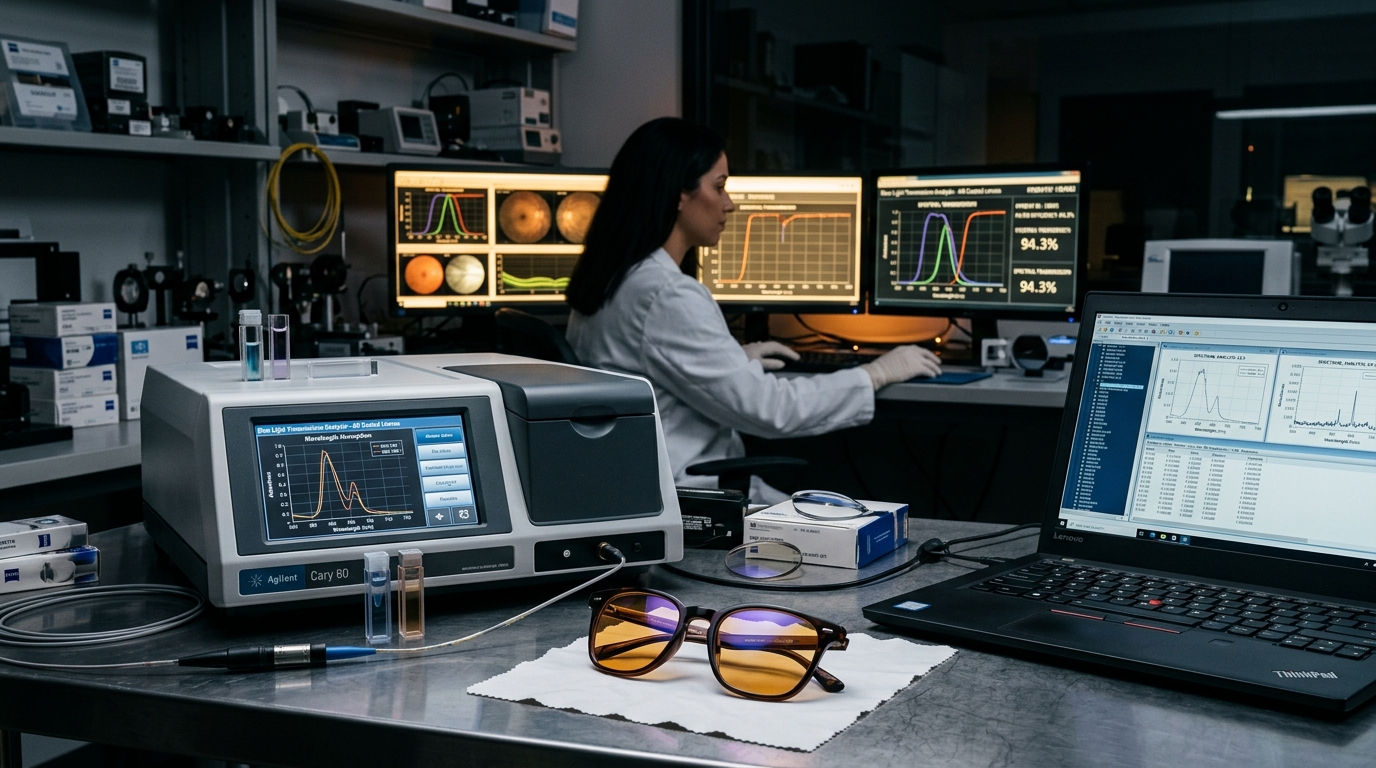
Spectrophotometer testing shows cheap generic glasses often filter an identical amount (10% to 20%) of high-energy visible light compared to $100+ designer optometry coatings. However, neither provides therapeutic relief from digital eye strain according to clinical trial data.
When is wearing blue light blocking glasses actually medically justified?
Wearing high-filtration amber or orange lenses (filtering >90% of wavelengths up to 500 nm) is clinically justified in the late evening (within 2 hours of bedtime) for individuals with delayed sleep phase syndrome, insomnia, or individuals required to work on high-intensity screens right before sleep.
Related Science & Health Deep Dives
- Screen Time Limits That Actually Improve Focus (Based on Studies)
- Why Humans Need Sleep: The Science Behind Rest, Brain Function, and Health
- How Accurate Is Your Smartwatch? 2026 Clinical Data Comparing Apple, Garmin, & Oura
- Why Mental Exhaustion Feels Worse Than Physical Tiredness: The Science of Cognitive Fatigue
- Why People Scroll Without Remembering What They Watched: The Science of Digital Amnesia