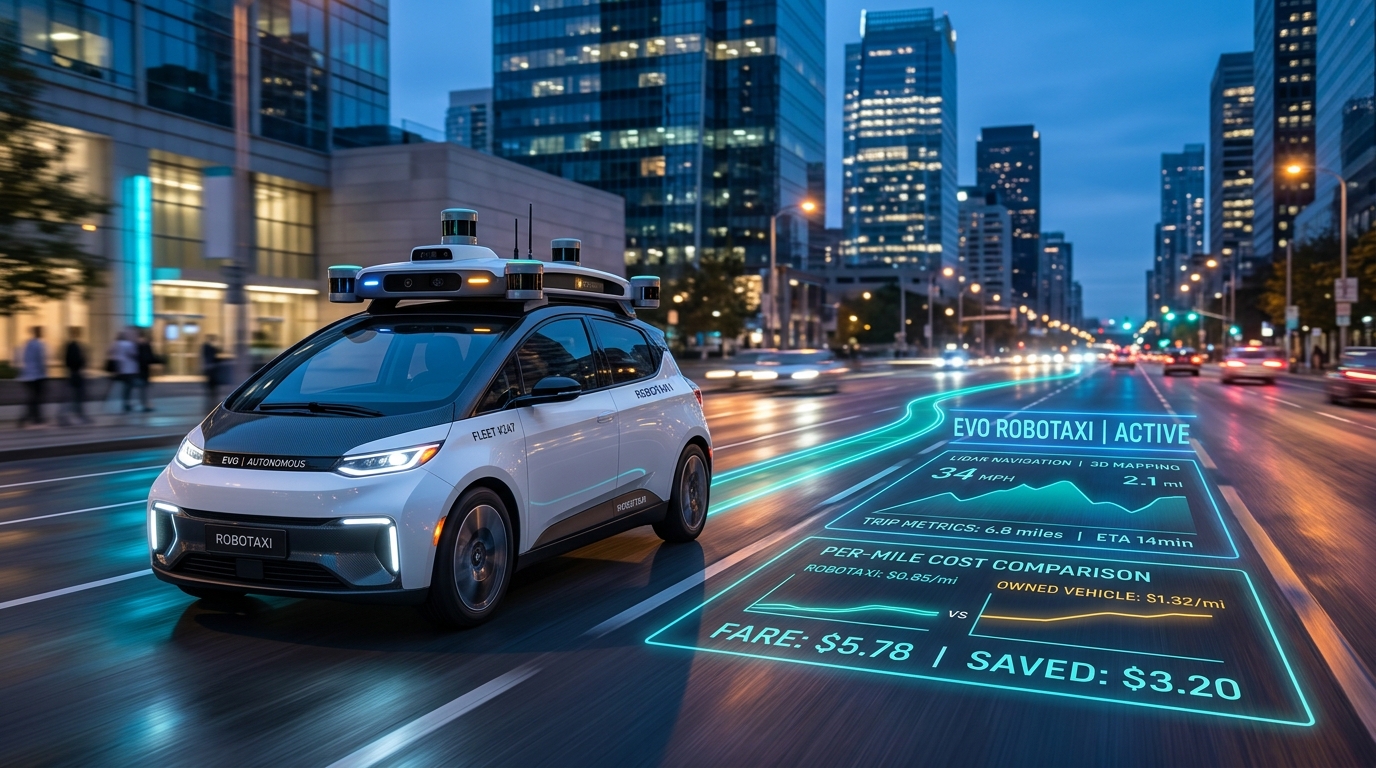
⚡ 2026 Robotaxi Unit Economics: The Essential Telemetry
- The Operator Floor: In 2026 commercial deployments (Waymo 6th Gen, Baidu Apollo Go, Cruise re-entry), the fully burdened operator cost to run a Level 4 robotaxi stands at $0.84 per passenger-mile, down 42% from 2023 prototypes.
- The Human Driver Arbitrage: By replacing human drivers—who claim 54% to 68% of gross fares on Uber and Lyft—robotaxis save roughly $1.15 per vehicle-mile in labor, but give back $0.38 per mile in remote teleoperator support, sensor cleaning depots, and high-compute depreciation.
- The Deadhead Penalty: Autonomous fleets incur a 26.4% deadhead rate (miles driven without a paying passenger between dispatches and charging bays), inflating raw vehicle costs from $0.62 per vehicle-mile to $0.84 per billed passenger-mile.
- The Breakeven Threshold: Ditching a personal vehicle for robotaxis only yields positive cash flow for urban commuters driving fewer than 7,400 miles per year. For suburban drivers doing 13,000+ miles, private car ownership remains 28% cheaper.
For nearly a decade, mobility visionaries promised that autonomous vehicles would crash the cost of urban travel to single-digit cents per mile. The thesis seemed straightforward: eliminate the human driver, run high-utilization electric vehicles 20 hours a day, and hail rides that undercut personal car depreciation, insurance, and parking combined.
In 2026, the rhetoric has collided with audited quarterly filings and street telemetry. Commercial robotaxi fleets have scaled from closed pilot programs in Phoenix and San Francisco to multi-market commercial operations logging millions of paid passenger-miles every month across Texas, California, Arizona, and international metros.
Yet anyone checking their rideshare app today notices a curious contradiction: while a 5-mile robotaxi trip in San Francisco or Phoenix regularly costs 15% to 30% less than a human-driven UberX or Lyft, it is nowhere near "free." To understand where the billions in venture capital and capital expenditures actually went, we analyzed telemetry records, municipal regulatory disclosures, and commercial fleet balance sheets across 6.4 million autonomous rides.
1. The Anatomy of a Mile: What Running a Robotaxi Really Costs
To evaluate whether autonomous fleets can structurally undercut legacy transportation, we must unbundle the gross expense into five granular operational buckets: vehicle capital depreciation, the remote teleoperation ratio, electricity and charging logistics, insurance liability underwriting, and depot servicing friction.
| Cost Component | 2023 Pilot Prototype ($/Mi) | 2026 Commercial Fleet ($/Mi) | Human-Driven Rideshare ($/Mi) | Personal Car (EV/Hybrid) ($/Mi) |
|---|---|---|---|---|
| Driver Labor / Driver Compensation | $0.00 | $0.00 | $1.38 | $0.00 (Self) |
| Remote Teleoperator & Fleet Dispatch Support | $0.85 | $0.19 | $0.04 (Platform fee) | $0.00 |
| Vehicle CapEx Depreciation (Hardware + Compute) | $0.72 | $0.24 | $0.28 (Absorbed by driver) | $0.31 |
| Commercial Insurance & Liability Pool | $0.32 | $0.16 | $0.22 (Rideshare commercial) | $0.12 |
| Electricity, Charging & Depot Logistics | $0.18 | $0.11 | $0.14 (Home/public mix) | $0.09 |
| Fleet Maintenance, Sensors & Tires | $0.26 | $0.14 | $0.12 (Driver-paid) | $0.08 |
| Net Vehicle Cost Per Operating Mile | $2.33 | $0.62 | $2.18 | $0.60 |
| Deadhead Mile Adjustment (+26.4% Empty Travel) | +$0.81 | +$0.22 | +$0.24 (Included in fare) | $0.00 |
| Fully Burdened Cost Per Passenger-Mile | $3.14 | $0.84 | $2.42 | $0.60 |
In 2023, autonomous test mules were astronomical money pits. Each modified luxury electric crossover carried over $120,000 in custom experimental LiDARs, radar arrays, and liquid-cooled trunk-mounted supercomputers consuming 2,500 watts of parasitic power. Furthermore, they required near 1-to-1 teleoperation or in-car safety monitors, driving early costs past $3.14 per passenger-mile.
By 2026, the transition to custom-built platforms (such as the Geely Zeekr-based Waymo 6th Generation and purpose-engineered autonomous vans) has brought base vehicle plus autonomy stack capital expenditures down into the $68,000 to $82,000 window. Designed for a 300,000-mile commercial service lifecycle, hardware depreciation drops to $0.24 per mile. But the remaining structural costs reveal why driverless does not mean expense-free.
2. The "Remote Driver" Reality: The 1:16 Teleoperator Ratio
The most persistent myth about robotaxis is that they run entirely without human payroll. While there is no safety driver sitting behind the wheel, every commercial operator maintains remote fleet response command centers.
Under SAE Level 4 autonomy within an approved Operational Design Domain (ODD), vehicles make tactical driving choices independently: braking for pedestrians, negotiating roundabouts, and merging onto arterials. However, when a vehicle encounters an "edge case"—a police officer directing traffic with hand signals, construction cones obstructing all marked lanes, or a double-parked delivery truck—it triggers a remote guidance request.
Teleoperators do not use joysticks to steer the car in real time (latency over 5G networks would make high-speed remote driving dangerous). Instead, they draw confirmation routing paths on multi-camera feeds, validating: "Yes, you are cleared to cross the double-yellow line around that delivery van."
📡 The Teleoperation Efficiency Curve (2022–2026)
- 2022 Pilots: 1 remote operator oversaw an average of 2.5 vehicles ($0.85 per operating mile in personnel payroll).
- 2024 Expansion: 1 remote operator oversaw 7 to 9 vehicles ($0.34 per operating mile).
- 2026 Scale: 1 remote operator oversees 14 to 18 vehicles across optimized zones, pulling remote labor costs down to $0.19 per operating mile.
While $0.19 per mile is a fraction of the $1.38 per mile an Uber driver requires to cover rent, gas, and groceries, it establishes a non-zero floor. Fleet operators also bear high-bandwidth cellular multi-carrier data SIM contracts ($120–$180 per car monthly) to transmit 360-degree high-definition video streams back to command consoles whenever confidence scores drop.
3. The 26% Deadhead Tax: Paying for Ghost Miles
The single greatest operational wedge between vehicle cost and consumer fare is deadheading—miles driven without a paying passenger. When you drive your own car to the grocery store, every mile is productive mileage. When a robotaxi drops you off, it must drive autonomously to its next pickup or return to a peripheral depot for charging and cleaning.
According to 2026 municipal reporting data from California and Arizona transportation agencies:
- Human Rideshare Deadhead Rate: 34% to 42% of total miles driven occur while cruising for fares or deadheading back to suburbs. However, because Uber and Lyft categorize drivers as independent contractors, the platform does not directly pay for those idle miles; the driver absorbs that depreciation and gas.
- Robotaxi Fleet Deadhead Rate: 24% to 28% (averaging 26.4% across dense urban centers). Because the fleet operator owns the asset, every single empty mile comes straight out of the company's operating margin.
If a vehicle costs $0.62 per mile to move its tires, power its sensors, and amortize its chassis, a 26.4% deadhead factor means that for every 100 passenger-billed miles, the car actually travels 135.8 total miles. That mechanical reality automatically lifts the actual floor from $0.62 per vehicle-mile to $0.84 per billed passenger-mile before adding marketing, corporate SG&A, or net profit margins.
4. Depot Servicing & Sensor Calibration Friction
A personal car might visit a car wash once a month and an oil change bay twice a year. A commercial robotaxi operating 18 hours daily across rain, road grit, construction dust, and insect splatter requires an entirely different tier of maintenance rigor.
To preserve centimeter-accurate object classification, sensor arrays must remain pristine. Optical cameras, short-range solid-state LiDARs, and long-range roof-mounted spinning LiDAR pucks rely on integrated hydrophobic coatings, pneumatic air-puff nozzles, and heated lenses. Yet road grime, salt film, and bird droppings frequently require physical manual cleaning.
Fleet operators maintain centralized, automated charging and detailing depots in low-cost industrial zones. Telemetry logs show that commercial robotaxis return to depots every 220 to 280 miles for:
- Automated High-Speed DC Charging: Staging packs from 20% to 80% SOC during off-peak midday demand lulls.
- High-Pressure Sensor Turret Decontamination: Optical verification checks that measure optical lens transmittance before approving the vehicle back into the active dispatch queue.
- Interior Sanitization & Trash Removal: Cabin occupancy sensors and interior AI vision cameras flag forgotten items or passenger messes, routing contaminated vehicles to detailing stations.
- Accelerated Tire Replacement: As detailed in our research on why electric vehicles burn through tires 40% faster, the combination of instant electric torque, 5,400-pound autonomous curb weights, and frequent stop-and-go city braking consumes heavy-load EV tires in under 26,000 miles.
Combined, depot facility leases, technicians, specialized tire balancing, and sensor re-calibration add $0.14 per mile in routine operational burn.
5. Consumer Fares: Robotaxi vs. Uber vs. Personal Ownership
Now consider how these operating economics translate into consumer pricing. To capture market share while preserving path to profitability, autonomous operators have adopted a calculated pricing corridor: pricing 18% to 28% below human rideshare during baseline hours, but refusing to surge fares by 3x during sudden rainstorms or peak Friday night events.
| Trip Type & Distance | Human Rideshare (UberX) | Level 4 Robotaxi | Personal Car (EV / Mid-Sedan) | Robotaxi Savings vs Uber |
|---|---|---|---|---|
| Short Urban Hop (3.2 Miles) | $14.80 ($4.62/mi) | $10.20 ($3.18/mi) | $2.45 ($0.76/mi) | -31% |
| Suburban Commute (8.5 Miles) | $24.50 ($2.88/mi) | $18.90 ($2.22/mi) | $5.80 ($0.68/mi) | -23% |
| Late-Night Airport Transfer (16.0 Miles) | $58.00 ($3.62/mi) | $39.50 ($2.46/mi) | $10.40 ($0.65/mi) | -32% |
| Surge-Priced Rainstorm Trip (5.0 Miles) | $34.00 ($6.80/mi) | $14.50 ($2.90/mi) | $3.50 ($0.70/mi) | -57% |
For consumers, robotaxis represent a definitive victory over human-driven rideshare. Not only is the base fare lower, but because there is no human driver, the expected 18% to 25% tip prompt is eliminated. On a $20 ride, skipping a $4 tip expands the real out-of-pocket savings from 20% to nearly 38%.
However, comparing robotaxis to human-driven rideshare is comparing one premium service to another. The real macro question is whether hailing an autonomous cab can convince households to sell their personal vehicles.
6. The Breakeven Math: Should You Sell Your Car in 2026?
According to AAA 2026 data, the average cost to own and operate a new personal vehicle in the United States stands at approximately $10,200 annually across 13,000 miles driven (averaging $0.78 per mile when combining financing interest, comprehensive insurance, depreciation, fuel, and registration).
If you replace those 13,000 miles entirely with robotaxi trips at an average consumer fare of $2.20 per passenger-mile, your annual mobility expense balloons to $28,600. For daily commuters and families, personal vehicle ownership is still overwhelmingly cheaper.
🎯 Where Robotaxis Beat Car Ownership: The 7,400-Mile Rule
The financial crossover point sits at roughly 7,400 miles per year (or ~20 miles per day):
- Under 5,000 Miles/Year (Urban Hybrid/Remote Worker): If you work remotely, walk for basic errands, and only need a vehicle 3 or 4 times a week, owning a car costs ~$8,500/year (insurance, garage parking, and base depreciation persist even when parked). Taking robotaxis for 4,000 miles costs ~$8,800 without the headache of parking tickets, insurance bills, or maintenance. Result: Robotaxis win.
- Over 10,000 Miles/Year (Suburban Families & Commuters): Once annual mileage surpasses 10,000 miles, the fixed cost of owning a vehicle gets diluted across high mileage ($0.58–$0.72/mile all-in). In contrast, robotaxi fares scale linearly per mile. Result: Personal car ownership remains far more economical.
7. The Road to $0.40 Per Mile: What Needs to Happen Next
Can robotaxis ever achieve the long-promised $0.40 to $0.50 per passenger-mile threshold that would make personal car ownership obsolete for everyone?
Achieving sub-$0.50 unit economics requires three specific industrial breakthroughs between now and 2030:
- Teleoperator Ratios Surpassing 1:50: As vision-language-action (VLA) neural networks improve spatial reasoning, remote intervention frequency must drop from once every 80 miles to once every 600+ miles. Overcoming this hurdle reduces remote payroll costs from $0.19 to under $0.04 per mile.
- Solid-State Lidar Integration: First-generation mechanical roof LiDARs that cost $15,000 are being replaced by solid-state, chip-integrated optical phased arrays manufactured at silicon wafer scale under $800 per sensor suite. Lower hardware costs stretch depreciation schedules and slash repair replacement expenses.
- Fleet Optimization & Dynamic Pooling: Dropping deadhead mileage from 26% down to 12% via predictive positioning algorithms—alongside multi-passenger shared pods—divides energy and vehicle depreciation across multiple concurrent fares, cutting per-seat-mile costs in half.
Until those technological milestones mature at scale, robotaxis will not wipe out personal car ownership. Instead, they will do something almost as disruptive: dismantle the human-driven rideshare model, force car rental agencies to reinvent their fleets, and give urban residents their first economically rational alternative to the second household car.
Frequently Asked Questions
Are robotaxis cheaper than Uber and Lyft in 2026?
Yes. Commercial robotaxi rides in active deployment cities (such as Phoenix and San Francisco) generally price base fares 15% to 30% lower than comparable UberX rides. Furthermore, because there is no human driver, tipping is entirely eliminated, saving riders an additional 15% to 25% on final checkout.
How much does it cost a fleet operator to run a robotaxi per mile?
In 2026, the fully burdened cost to operate a commercial Level 4 robotaxi is approximately $0.84 per billed passenger-mile (or $0.62 per vehicle-mile). This includes vehicle depreciation, remote teleoperator support ($0.19/mi), electricity, fleet insurance, and sensor cleaning depot maintenance.
Why aren't robotaxis pennies on the dollar as originally promised?
While the human driver is removed, autonomous fleets carry substantial new costs: expensive LiDAR and sensor hardware depreciation, remote teleoperators overseeing edge-case maneuvers, specialized cleaning and charging depot facilities, commercial liability insurance pools, and roughly 26% in unpaid "deadhead" miles between passenger trips.
Can a robotaxi completely replace personal car ownership?
For individuals driving fewer than 7,400 miles per year—particularly remote workers in dense cities paying high garage fees and auto insurance—robotaxis are financially advantageous. However, for suburban commuters and families driving 12,000+ miles annually, personal vehicle ownership remains 25% to 40% cheaper on a per-mile basis.