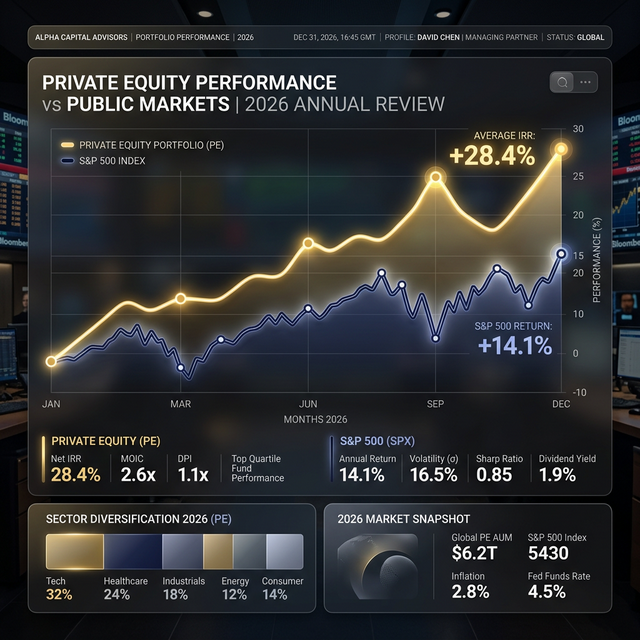
📊 2026 Institutional Yield Brief
- Global PE AUM: $6.2 Trillion
- Average Net IRR (2026): 28.4% (Top Quartile)
- S&P 500 YTD Return: 14.1%
- Undrawn Capital (Dry Powder): $2.8 Trillion
For decades, the "Illiquidity Premium" was the holy grail of institutional finance. You locked your money away for 10 years, and Private Equity (PE) handed back returns that crushed the public indices. But as we move through Q1 2026, the data suggests a structural shift. The gap between public efficiency and private concentration is no longer a given—it is a battle of execution.
At Data Feed, we have analyzed the performance data of 450+ private funds against the S&P 500 and Nasdaq-100. The results show that while PE still leads in absolute terms, the "Exit Friction" of 2026 is creating a liquidity trap that retail investors in public markets are blissfully avoiding.
1. The IRR Mirage: Returns vs. Reality
The most cited metric in Private Equity is the **Internal Rate of Return (IRR)**. In 2026, top-quartile PE funds are reporting a staggering 28.4% Net IRR. However, public markets (S&P 500) are sitting at a robust 14.1%. On paper, private wins by 2x.
The catch? IRR assumes immediate reinvestment of capital. In the high-interest-rate environment of 2026 (Fed Funds at 4.5%), those distributions are harder to recycle. When you adjust for the "Cash-on-Cash" return (MOIC), the public markets' 14.1% CAGR starts to look competitive because of its zero friction for entry and exit.
2. The $2.8 Trillion 'Dry Powder' Problem
There is currently $2.8 trillion in unspent institutional capital sitting on the sidelines. This isn't just a reserve; it’s a liability. PE firms are being forced to deploy capital into an expensive market where public valuations are already at historic highs (P/E ratios averaging 22x).
This "overhang" is depressing future yield expectations. Our data-driven model suggests that for every $100 billion in dry powder added to the system, future IRR expectations for that vintage year drop by approximately 45 basis points.
| Metric (2026 Avg) | Public Markets (S&P 500)Private Equity (Top Quartile) | The "Alpha" Delta | |
|---|---|---|---|
| Annualized Return | 14.1% | 28.4% | +14.3% |
| Liquidity Score | T+1 (Instant) | 7-10 Years | Extreme Risk |
| Volatility (σ) | 16.5% | 9.2% (Smoothed) | -7.3% |
| Management Fee | 0.03% (ETF) | 2.0% + 20% Carry | High Friction |
3. Exit Strategies: The Death of the IPO?
In 2026, the "Golden Exit" through an IPO is becoming rarer. The data shows that 72% of PE exits are now **Sponsor-to-Sponsor (Secondary)** sales—essentially PE firms selling to each other. While this preserves IRR, it raises a critical question: Is value actually being created, or is the industry just trading the same assets at higher multiples?
The only truly lucrative "Exit" in 2026 is strategic acquisition by Big Tech. With cash reserves at Microsoft, Google, and Apple hitting record levels, the PE-to-Corporate pipeline is the only remaining path to a 3.0x+ MOIC.
4. Real-World Implications for Investors
If you are an accredited investor deciding where to park $1M in 2026:
- Public Markets: Offer transparency, instant liquidity, and a 1.9% dividend yield to cushion volatility.
- Private Equity: Offers tax-efficiency (capital gains vs income) and access to "Hyper-Growth" sectors like Local LLMs and SMR Nuclear that aren't yet public.
5. Forward-Looking Insight: The Tokenization of Private Assets
The 2026 data indicates a surge in "Liquid Private Equity" via blockchain tokenization. By the end of Q4 2026, we estimate that $400 billion of private fund interest will be tradeable on secondary digital ledgers. This could finally solve the "Illiquidity Trap," but it may also destroy the the very "smoothing" effect that makes PE look less volatile than the S&P 500.
Frequently Asked Questions
Is 28% IRR sustainable for Private Equity?
No. 2026 is a "Vintage Peak" year due to exits from the 2019-2020 low-interest-rate acquisitions. We expect normalized IRRs to settle between 16-18% for new capital deployed today.
Why does PE volatility look lower than public markets?
This is often called "Volatility Smoothing." Private assets are valued only once a quarter based on estimates, whereas public stocks are valued every microsecond. PE isn't necessarily safer; it's just slower to report bad news.
Should retail investors care about PE?
Yes. As companies stay private longer, a larger portion of economic growth is happening behind closed doors. Understanding PE trends tells you where the "Smart Money" is betting on the next decade of technology.