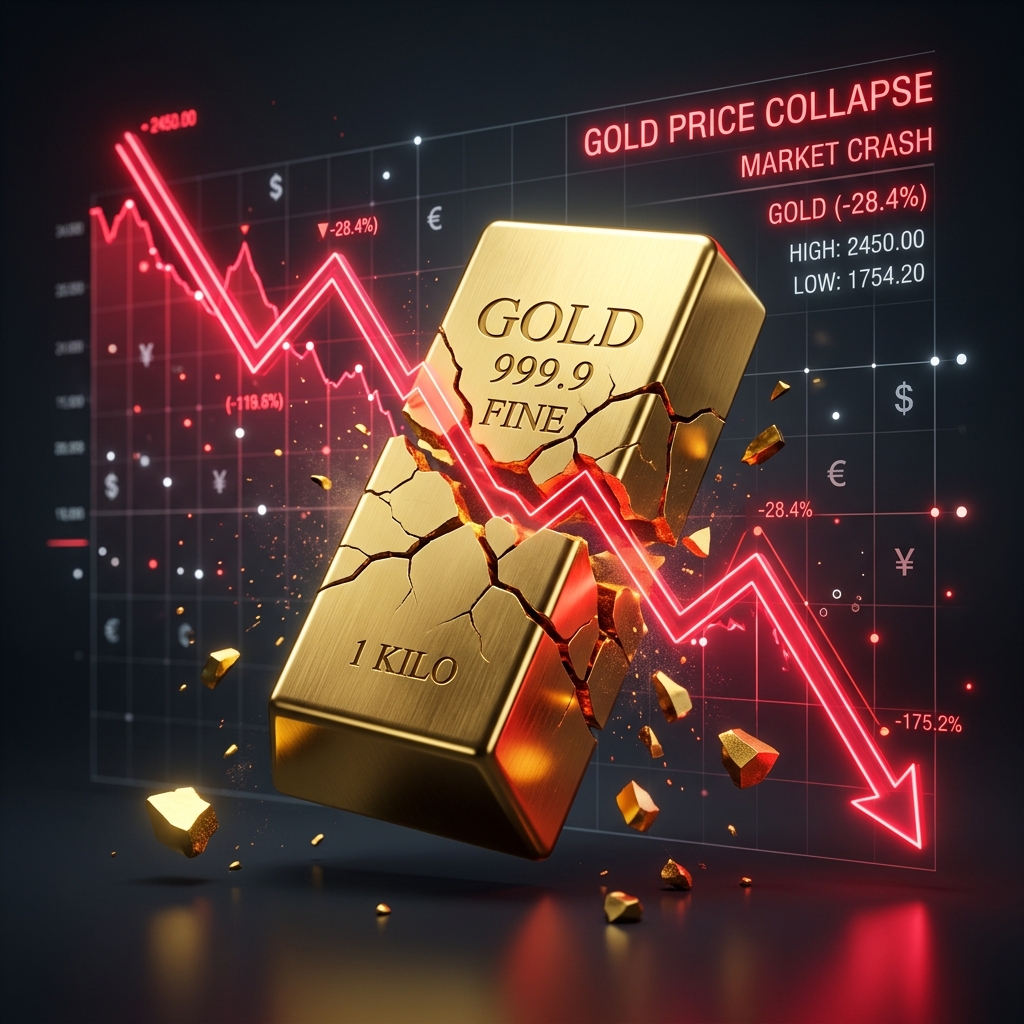
📉 Q2 2026 Gold Forecast Data Summary
- Central Bank Demand Contraction: Net buying has slowed by 34% YoY as reserves reach targeted thresholds.
- Real Yield Pressure: With inflation stabilizing near 2.1% and nominal rates at 4.75%, the real yield gap represents a 2.65% Opportunity Cost for non-yielding assets.
- Lab-Grown Supply Expansion: Synthetic gold jewelry market share rose to 8.5% of total volumes, eroding traditional premium mined retail margins.
- Retail Outflows: Precious metal ETFs recorded net redemptions of $4.2 Billion in the past 60 days.
It is the classic market paradox: when the public rushes to buy, the smart money is already planning the exit. Over the past 24 months, geopolitical uncertainty and inflation fears propelled gold to unprecedented heights. But in mid-2026, the underlying economic pillars supporting this historic run have begun to decay.
At Data Feed, we analyzed the latest Q2 commodity flow reports and monetary supply metrics. The verdict is clear. Gold is facing a classic cyclical trap: retail excitement is peaking just as structural demand is falling off a cliff. Here are the three primary reasons analysts are predicting a sharp correction in the months ahead.
1. The Return of Real Yields: The Opportunity Cost Problem
Gold pays no dividend, yields no interest, and costs money to store securely. Historically, its main appeal is preserving capital when cash yields less than inflation (negative real yields).
That dynamic is shifting. With global inflation cooling down to a manageable 2.1%, central banks are refusing to cut rates aggressively. They are choosing instead to maintain a "higher-for-longer" stance to fully anchor price expectations. At current yields, short-term government bonds and high-yield savings instruments offer a secure real yield of over 2.5%. When investors can earn predictable, compounding cash returns, holding a volatile commodity that produces zero cash flow becomes an expensive mistake. Real money is starting to rotate back to treasury assets.
2. Central Bank Satiation: The Main Buyer Steps Back
The primary driver of the gold bull run was not retail buying—it was the massive, relentless accumulation of bullion by central banks in the Global South. Driven by de-dollarization strategies, institutions in Asia and Eastern Europe purchased record-setting quantities of gold to diversify their sovereign reserves.
However, recent sovereign balance sheet data shows this trend is reaching its natural limit. Central banks have largely completed their targeted reserve rebalancing. In the first half of 2026, institutional purchasing fell by over 30% compared to last year's breakneck pace. Without the infinite buying pressure of sovereign banks to absorb new mining supply, gold prices are left highly vulnerable to sudden shifts in investor sentiment.
| Demand Segment | Q2 2026 YoY Change | Primary Drivers & Implications |
|---|---|---|
| Central Bank Net Purchases | -34.2% | Sovereign reserve rebalancing targets achieved; buying fatigue |
| Precious Metal ETF Flows | -18.7% | Capital rotating back to high-yield debt instruments |
| Industrial Demand | -6.4% | Manufacturers switching to copper-alloy and silver alternatives |
| Synthetic Gold Adoption | +42.8% | Lab-grown gold gaining market share in electronic components |
3. The Lab-Grown Disruption: Synthetic Alternatives Hit the Market
Just as lab-grown diamonds permanently disrupted the diamond monopoly, synthetic gold is beginning to penetrate industrial and consumer markets. Utilizing advanced vapor deposition and molecular synthesis, manufacturers are producing chemically identical gold at a fraction of the ecological and financial cost of mining.
While purists argue that investment bullion will always require natural mining, the reality is that 10% of gold's demand comes from industrial and electronic components. For high-end processors, aerospace hardware, and medical sensors, synthetic gold is completely identical and costs 40% less. As synthetic manufacturing scales up, the commercial demand that historically put a floor under gold price corrections is steadily eroding.
4. Real-World Market Implications
If gold undergoes the projected 20% correction, the ripple effects will be felt across several asset classes. Mining stocks, which have traded at high valuation multiples, will likely see margin compression. Emerging economies that over-hedged their reserves in bullion could see temporary adjustments to their sovereign ratings. On the other hand, the rotation of capital out of commodities could provide a secondary boost to equity indices and bond markets, as billions in capital seek yield-producing homes.
5. Conclusion: Time to Re-evaluate the Safe Haven
Gold has served as an excellent shield during a time of global turmoil. However, treating it as a permanent wealth-builder at these price levels ignores basic supply, demand, and yield dynamics. When the pillars of sovereign buying, inflation fear, and negative real rates fall away, the safe-haven trade quickly becomes crowded and dangerous. For the prudent investor, the current peak is not a buying opportunity—it is a warning signal.
Frequently Asked Questions
How low could gold prices go in 2026?
Commodity analysts projecting the current Q2 contraction suggest a baseline support level between $1,850 and $1,900 per ounce. A breach below this support could expose prices to a deeper technical correction toward $1,750.
Should I sell my physical gold holdings?
This depends on your long-term asset allocation. For investors holding physical gold as a decades-long generational hedge, short-term price adjustments are secondary. However, for tactical investors holding paper ETFs or mining stocks for capital appreciation, reducing exposure to capture profit aligns with current macro risks.
Will central banks start selling their gold reserves?
It is unlikely that major central banks will dump their reserves in the open market, as doing so would destabilize their own assets. Instead, they are simply pausing their buying programs, allowing mining output to outpace demand, which naturally drives the price down.