📊 Global Cashless Transition Key Findings
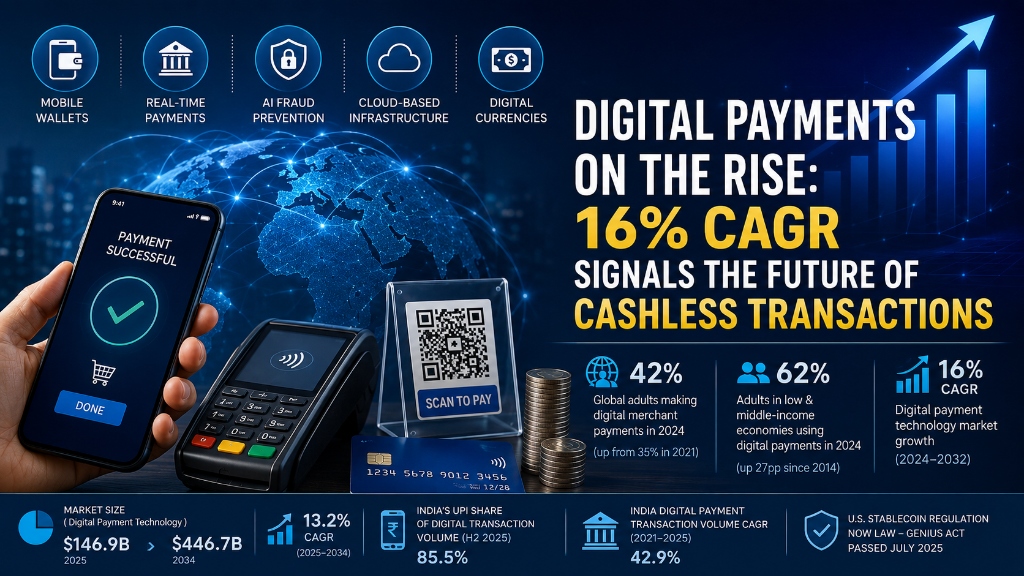
- Rapid Market Expansion: The broader digital payments industry is expanding at roughly 16% CAGR through 2032, while the core payment technology segment (software, cloud rails, AI fraud engines) is on track to nearly triple from $146.9B in 2025 to $446.7B by 2034.
- World Bank Findex Shift: 42% of global adults made digital merchant payments in 2024 (up from 35% in 2021). In low- and middle-income economies, 62% of adults now use digital payments—a massive 27 percentage point jump since 2014.
- Real-Time Rails Dominion: India's UPI handled 85.5% of total digital transaction volume in H2 2025 with a 42.9% CAGR between 2021 and 2025, serving as the global blueprint for real-time payments.
- Regulatory Catalysts: U.S. passage of the GENIUS Act (July 2025) provides the first clear federal compliance framework for payment stablecoins, unlocking institutional blockchain settlement.
Money's days as king of the world economy are quickly counting down, much quicker than predicted only two years ago by industry experts. Digital payment technology is expected to grow at a CAGR of 16 percent from 2024 through 2032, driven by smartphone adoption, cashless initiatives supported by governments, and fraud prevention solutions powered by AI technology.
That trajectory isn't speculative. It's backed by both dedicated market research and hard government data. According to the World Bank's Global Findex Database 2025, digital merchant payments for adults worldwide increased to 42% in 2024 from 35% in 2021. Meanwhile, 62% of adults in low and middle-income countries made a digital payment in 2024, which was up 27 percentage points from 2014.
1. Market Snapshot: Numbers Speak
The global shift toward digital transaction rails can be observed across both aggregate payment volumes and the underlying technology stack that powers them:
| Metric | 2025 Base | 2034 Forecast | CAGR |
|---|---|---|---|
| Global digital payment technology market (Dataintelo) | $146.9B | $446.7B | 13.2% |
| Broader digital payments market (industry estimate) | — | — | ~16% |
| Government Data Point | Figure | Source |
|---|---|---|
| People from all over the world that make payment to the merchants online (35% in 2021; 42% forecast for 2024) | 42% | World Bank Global Findex 2025 |
| Adults in low/middle-income economies making digital payments (2024, up 27pp since 2014) | 62% | World Bank Global Findex 2025 |
| India's UPI share of digital transaction volume (H2 2025) | 85.5% | Reserve Bank of India, via Press Information Bureau |
| India digital payment transaction volume CAGR (2021–2025) | 42.9% | Government of India (DD News) |
Digital Payment Technology Market Reports that acts as an anchor reference for this article indicate that modern transaction infrastructure, projecting the core technology market to nearly triple by 2034.
2. Recent Developments Shaping the Market
The digital payments ecosystem has experienced remarkable acceleration over the past 18 months due to decisive policy and infrastructure upgrades across major financial jurisdictions:
- U.S. Stablecoin Regulation Passed into Law: The GENIUS Act (S.1582), passed by the U.S. Congress in July 2025, establishes the first clear federal compliance framework for payment stablecoins. By enforcing 1-to-1 liquid reserve backing and strict AML oversight, it has opened the floodgates for institutional blockchain-based settlement.
- Real-Time Payment Rails Scaling in the U.S.: The Federal Reserve's FedNow Service has continuously expanded bank and credit union participation, enabling instant, 24/7/365 settlement across commercial networks and federal agency disbursements.
- India's UPI World Volume Leadership: According to the Reserve Bank of India, published via the Press Information Bureau, India's Unified Payments Interface (UPI) recorded over 24,162 crore transactions in FY 2025-26 alone, with the RBI targeting UPI connectivity across 20 nations by 2029.
- Global Financial Inclusion Gains: World Bank data shows global account ownership reached 79% in 2024 (up from 51% in 2011), driven by mobile money account creation across Latin America, South Asia, and Sub-Saharan Africa.

3. Key Growth Drivers Through 2032
Six primary engines are pushing global transaction volumes away from physical cash and toward instant digital clearance:
- Smartphone and Mobile Wallet Penetration: With 86% of global adults owning a mobile phone, mobile wallets (accounting for 38.5% of payment mode share) serve as the default bank account for billions.
- Account-to-Account (A2A) Real-Time Rails: State-backed rails like FedNow and UPI eliminate multi-day settlement delays, allowing merchants to bypass high credit card interchange fees.
- Regulatory Certainty for Digital Assets: Frameworks like the U.S. GENIUS Act replace ambiguity with standardized compliance, unlocking corporate treasury integration.
- Financial Inclusion in Emerging Economies: Low-cost QR code acceptance enables small merchants and micro-entrepreneurs to accept payments instantly without expensive POS terminals.
- Cloud-Based, API-First Architectures: Cloud deployments represent 61.7% of payment technology infrastructure, allowing financial institutions to deploy AI fraud detection engines seamlessly.
- Cross-Border Interoperability: Initiatives such as Project Nexus connect instant payment networks globally, facilitating low-fee cross-border remittances.
4. Business and Investor Key Takeaways
1. Infrastructure is Cloud-Native: On-premise payment architectures are structurally declining as enterprises migrate toward cloud services for real-time compliance updates and scalability.
2. SME Market Surge: Small and medium enterprises (SMEs) represent the fastest-growing enterprise buyer segment, adopting cloud-native payment platforms previously accessible only to giant retailers.
3. Public Real-Time Rails Outpacing Private Cards: Government-backed real-time rails are experiencing significantly higher transaction volume growth rates than traditional card networks.
4. Regulation as a Growth Enabler: Clear statutory frameworks (like stablecoin legislation) are removing institutional risk barriers, accelerating capital allocation into payment tech.
5. Frequently Asked Questions (FAQ)
Q: Where does the 16% CAGR figure come from, and is it reliable?
It reflects widely cited industry forecasts for the global digital payments market through 2032. Specialized researches on the payment technology software/infrastructure market indicates a 13.2% CAGR reaching $446.7 Billion by 2034.
Q: What government data best supports this global adoption trend?
The World Bank Global Findex Database 2025 showing digital merchant payment adoption growing from 35% in 2021 to 42% of global adults in 2024.
Q: Why is India's UPI relevant to global market predictions?
UPI is the world's largest real-time payment system by transaction volume. According to RBI metrics via DD News, UPI accounted for 85.5% of India's total digital transactions in H2 2025, demonstrating how rapidly government-supported digital public infrastructure can scale.
Q: How does U.S. stablecoin legislation impact payment tech?
The 2025 GENIUS Act provides legal certainty for reserve-backed payment stablecoins, enabling mainstream payment processors and financial institutions to build compliant, 24/7 cross-border settlement rails.
Looking Ahead
It is beyond dispute which way global payments are heading; the only questions left are how quickly cash usage declines and which technology stacks capture the majority of transaction flows. As user behavior permanently shifts toward instant digital payments, public real-time rails, digital wallets, and cloud infrastructure will continue to outpace traditional banking legacy systems through 2032 and beyond.
Data Sources & References: Digital Payment Technology Market Report, World Bank Global Findex Database 2025, Reserve Bank of India / Press Information Bureau, Government of India, U.S. Congress — GENIUS Act (S.1582), Federal Reserve FedNow Service, DD News.